Guest post: Central Banks Should Quit “Kicking Them While They Are Down!” (by David Eagle)

Guest post: Central Banks Should Quit “Kicking Them While They Are Down!”

– Abandon Inflation Targeting! Embrace NGDP Level Targeting!

By David Eagle

Homeowners in the U.S. and many other places in the world are struggling to meet their mortgage payments while their average nominal income has fallen in the aftermath of one of the worst recessions since the Great Depression of the 1930s.  Many sovereign governments in Europe are struggling to meet their debt obligations in the midst of reduced tax revenue caused by this recession.  On Monday, Feb. 13, 2012, many Greek citizens rioted in Athens against the austerity measures being passed by the Greek government under pressure from the European Union.  What do these homeowners, sovereign governments, and the Greek people have in common?  They are all victims.  They are victims of well-intentioned, but misguided central banks.

By explicitly or covertly targeting inflation, these central banks including the Federal Reserve of the U.S. and the European Central Bank have been “kicking these victims while they are down.”  These central banks are promising to continue kicking them while they are down in perpetuity.  I write this blog in hopes of ending the madness of this economic self-destruction.

In a previous guest blog at The Market Monetarist, I discussed why Price-Level Targeting (PLT) Pareto dominates Inflation Targeting (IT).  That blog’s conclusion followed from the realization that the uncertainty that borrowers and lenders face is not “inflation risk” but rather price-level risk.  It is then obvious that the long-term price-level risk faced by both borrowers and lenders is less under PLT than under IT.  Whenever the price level deviates from what was expected, either the borrower or the lender experiences a loss while the other experiences a gain.  Under PLT the central bank tries to reverse those losses or gains, whereas under IT the central bank tries to make those gains or losses permanent.  By making the losers’ losses permanent, IT “kicks them while they are down.”

IT is not the only monetary target that “kicks them while they are down.”  Many market monetarists and I have great respect for Bennett McCallum.  However, McCallum advocates what I nickname “ΔNT,” which is targeting the growth rate of nominal GDP.  The truth is that ΔNT “kicks them while they are down” just as much as does IT.  As I explained in one of my guest blogs at The Market Monetarist, both IT and ΔNT lead to NGDP base drift.  It is this evil NGDP base drift that “kicks them while they are down.”  As a result, central banks need to try to reverse any NGDP base drift in order to help lift economic agents back up after they have been knocked down by recessions.  The targeting regime designed specifically to eliminate NGDP base drift is what I nickname “NT.”  Under NT central banks target the level (not the growth rate) of NGDP; NT is the targeting regime advocated by most market monetarists.

The Evil NGDP Base Drift:

Let Xt be a prearranged nominal loan payment, and let xtXt/Pt be the real value of this nominal loan payment.  By the equation of exchange (MV=N=PY), we know that P=N/Y. Therefore, the real value of Xtis (Xt/Nt)Yt, which implies that the real value of Xt is proportional to Yt when Nt=E[Nt], which it will be under perfectly successful NT.

Define αtXt/Nt to be the actual proportion that the real value of this nominal payment is to RGDP.  Multiply the right side by Nt*/Nt* (which equals one) where Nt* is defined as the prerecession trend for NGDP (Under NT, Nt* would be the NGDP target).  Rearranging slightly gives:

(1) αt=(Xt/Nt*)(Nt*/Nt)

Define NGAP to be the percentage deviation of NGDP from its prerecession trend.  Hence, NGAPt≡(Nt─Nt*)/Nt*.  We can also write that NGAPt=Nt/Nt*-1, or 1+NGAPt = Nt/Nt*, which is the reciprocal of the last ratio in equation (1).  Define αt*Xt/Nt*, which is what αt would if Nt=Nt*, i.e., when NGAPt=0.  With this new definition and our understanding of NGAP, we can rewrite equation (1) as:

(2) αt= αt*/(1+NGAPt)

This states that the proportion that the real value of the nominal loan payment is of RGDP equals the proportion it would be if NGDP is on its prerecession trend divided by 1+NGAP.  Equation (2) is useful to show how borrowers and lenders are affected when NGDP deviates from its trend.  When NGDP rises above trend, NGAP becomes positive, decreasing this proportion, making borrowers better off at the expense of lenders; in other words, borrowers gain while lenders lose.  When NGDP falls below trend, NGAP becomes negative, increasing this proportion, making borrowers worse off and lenders better off; in other words, borrowers lose while lenders gain.

NGDP base drift occurs when NGAP becomes positive or negative, and the central bank accepts this NGAP and commits to keeping this NGAP in the future as it does both with IT and ΔNT.  This NGDP base drift then makes the effects on borrowers and lenders permanent.  On the other hand, under NT, the central bank tries to reverse these effects by returning NGAP to zero as soon as possible so that the effects on borrowers and lenders are temporary not permanent.

Because NGDP base drift causes the effects of NGAP on borrowers and lenders to be permanent, this NGDP base drift “kicks the loser when the loser is down.”  Hence, I view NGDP base drift as evil.

NGDP Targeting (NT) – The “Pi” or “e” of Monetary Economics

In my previous guest blog post where I explained why IT “kicks them while they are down,” I restricted that discussion to where real GDP (RGDP) remains the same.  That is because the First Principle from my blog on the Two Fundamental Welfare Principles of Monetary Economics states that Pareto Efficiency requires the consumption of individuals to be the same only as long as RGDP remains the same.  When RGDP changes, the Second Principle applies, which states that Pareto efficiency requires that the consumption of an individual with average relative risk aversion be proportional to RGDP.

NT helps individuals achieve this consumption proportional to RGDP by trying to make the real value of prearranged nominal payments (such as loan payments) proportional to RGDP.  NT does this by trying to keep NGAP equal to zero.  As seen in equation (2), as long as NGAP is zero and consumers expect NGAP to be zero, then this proportion will be proportional to RGDP.

Nominal contracts work efficiently in a Pareto sense whenever NGDP is as expected.  People are not trying to guarantee real payments between each other; rather they want to let the natural feature of nominal contracts properly distribute the RGDP risk among the parties of the contract.  As long as NGDP is as expected, the real value of the nominal contract’s payment will be proportionate to RGDP, which is what an individual with average relative risk aversion needs according to the Second Principle.

In a previous guest blog post, I noted that when RGDP remains the same, the uncertainty borrowers and lenders face is not inflation risk, but rather price-level risk.  While simple and obvious, that statement nevertheless has profound implications concerning the issue of price-level targeting (PLT) vs. IT.  However, when we broaden our perspective to include when RGDP changes, we need to go beyond the concept of price-level risk.  Instead of inflation risk or price-level risk, economic agents should really be concerned about NGDP risk.

NGDP risk is what I view to be the true monetary risk in an economy.  Minimizing NGDP risk helps meet both The Two Fundamental Welfare Principles of Monetary Economics.  First, by minimizing NGDP risk we minimize the price-level risk when RGDP does remain the same.   Second, minimizing NGDP risk helps consumption levels be proportional to RGDP by helping the real value of nominal payments to be proportional to RGDP.

Many proponents of NGDP targeting have described NGDP targeting as a reasonable compromise to the dual mandate of monetary policy.  That is not my view.

My view is that NGDP targeting is the ideal, not a compromise.  NGDP targeting comes out of theory as the Pareto-efficient monetary policy, much as in mathematics the numbers “pi” and “e” come out of pure theory.

Why NT Pareto Dominates ΔNT:

NT targets the level of NGDP whereas ΔNT targets the growth rate of NGDP.  As explained in my second guest blog post, as long as the central bank meets its target, NT and ΔNT have the same effect.  The difference between NT and ΔNT occurs when the central bank misses its target.  Under NT, when NGDP is less (greater) than its trajectory, the central bank tries to increase (decrease) NGDP back to its original trajectory.  However, with ΔNT the central bank “lets bygones be bygones” and shifts its NGDP trajectory to be consistent with its targeted NGDP growth.

When the central bank misses its target under NT or ΔNT, borrowers and lenders experience zero-sum gains and losses as a result of NGDP differing from expected NGDP.  For example, assume NGDP initially is 10 (trillion monetary units), the targeted growth rate for NGDP under ΔNT is 5%, and the targeted level of NGDP under NT is 10(1.05)t.  Then the initial NGDP trajectory under both NT and ΔNT is 10(1.05)t, and the public’s initial expectation of NGDP at time t is this NGDP trajectory of 10(1.05)t.  In particular, the public’s expectation of NGDP at time t=1 is 10.50.  However, assume NGDP1=10.29 instead of 10.50.  This means NGAP is -2%, which causes the proportion in equation (2) to rise, causing the borrowers to lose and the lenders to gain.  Under NT, the central bank tries to return NGDP back up to its initial trajectory where NGAP will be 0%.  On the other hand, under ΔNT the central bank shifts its NGDP trajectory from 10(1.05)t to 10.29(1.05)t-1, which means that the expected future NGAP will be -2%, meaning the borrower’s loss will be made permanent.  In other words, central banks following ΔNT “kick the losers (the borrowers in this case) when they are down.”

On the other hand, suppose NGDP1=10.71 instead of the 10.50 expected NGDP.  This is a positive NGAP of 2%, which implies that the proportion in equation (2) decreases, making the borrower better off at the expense of the loser.  With NT, the central bank will try to reverse its mistake and return to its initial NGDP trajectory, return NGAP to 0%, and return the proportion of the real payment to RGDP back to as originally expected.  However, with ΔNT, the central bank tries to make its mistake permanent, trying to keep NGAP at +2%, thus making the borrower permanently better off and the lender permanently worse off.

Thus, the difference between NT and ΔNT is that under NT, the central bank tries to reverse the losses and gains faced by both borrowers and lenders, whereas under ΔNT, the central bank tries to make those losses and gains permanent.  Thus, ΔNT “kicks the losers when they are down.”  A priori, both the borrower and lender are better off knowing that the central bank is going to reverse its mistakes rather than making its mistakes and the resulting gains and losses permanent.  Therefore, NT Pareto dominates ΔNT.

Real life example #1: Homeowners and Mortgages:

During the last recession, NGDP sharply fell and central banks have been experiencing significant negative NGDP base drift.  While some say that this negative NGDP base drift is due to central banks being unable to increase NGDP, the fact is that negative NGDP base drift has been associated with most U.S. recessions even when the Federal Reserve was by no means considered impotent (I will report these empirical findings in a later blog post).

The negative NGDP base drift has made borrowers worse off and the continuing of that NGDP base drift continues those borrowers’ misery.  For example, consider homeowners who before the recession bought homes and financed those with fixed-payment mortgages.  When NGDP fell below its expected trend, average nominal income fell below what the homeowners had expected.  On average, these homeowners were squeezed between reduced nominal income and their fixed mortgage payments.  With central banks continuing rather than reversing the negative NGDP base drift, these homeowners will continue to be squeezed until (i) they finally pay off their mortgage after greater financial strain than they expected, or (ii) they default on their mortgages because of their inability to pay them.   If central banks were to pursue NT, eliminating this NGDP base drift, reducing NGAP to 0%, then average nominal income would again be as initially expected, ending the squeeze on the average homeowner once the central bank returns to its NGDP target path.

However, as they have in past recessions, central banks are letting the negative NGDP base drift continue and are therefore kicking these borrowers while they are down.

Real life example #2: European Sovereign Governments:

When NGDP fell during the last recession in Europe, the reduction of NGDP resulted in lower tax revenues to sovereign governments, but these governments’ nominal loan payments were fixed, squeezing these governments.  The European Central Bank by allowing this NGDP base drift to continue are committing these governments to a perpetual squeeze; the European Central Bank is kicking these governments while they are down.

How bad is this negative NGDP base drift in Euro area?  See the following graph:
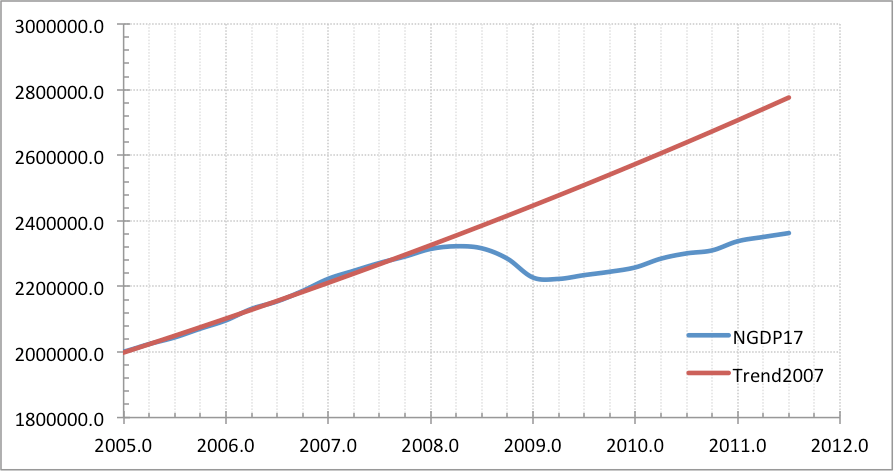
The negative NGDP base drift in the aftermath of the last recession in the Euro area is very significant.  However, this NGDP base drift is even more evil than normally.  Not only is NGAP significantly negative, but it keeps getting worse.  In the second quarter of 2009, NGAP was -10.28%.  Since then NGAP has continued to get worse reaching -14.90% in the third quarter of 2011.

If instead the European Central Bank were to target NGDP and try to return NGDP to its prerecession trend and were successful, these governments’ tax revenue should increase to initially expected levels, eliminating the squeeze.  Many will claim that the European Central Bank is impotent, unable to eliminate this NGAP.  However, as the following graph shows, the European Central Bank has experienced NGDP base previously when it was not impotent.
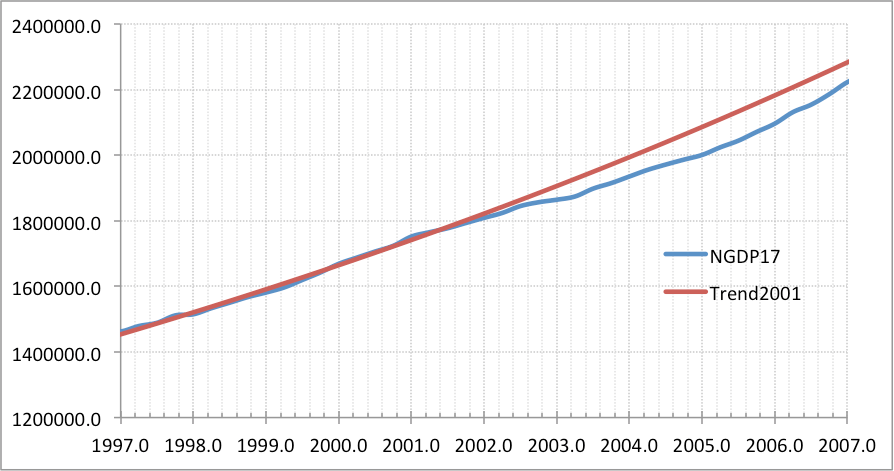
Because of my work with the issue of price determinacy, I know that expectations is very important to a central bank’s ability to meet its targets.  Since the European Central Bank has let NGDP base drift persist in the past, then the public’s expectation is that they will let the NGDP base drift persist now.  To succeed in eliminating this NGDP base drift, to return NGAP to zero, we need to change expectations.  By committing to NT and following other suggestions the market monetarists and I have, the European Central Bank can change these expectations and eliminate the evil of NGDP base drift.  Rather than kicking the sovereign government borrowers and other debtors while they are down, central banks can return NGAP to zero and help lift these debtors to their feet, which is a lot nicer than kicking them while they are down.

Making Both Borrowers and Lenders Worse off

Up until now I have described the negative NGDP base drift caused by ΔNT and IT as making borrowers worse off while making lenders better off.  However, the latest recession has made so many borrowers so worse off as to cause many borrowers be unable to pay, leading to loan defaults.  Hence, not only has this negative NGDP base drift made borrowers worse off, it has also made lenders worse off.  Reversing the negative NGDP base by following NT rather than IT or ΔNT would thus help not only borrowers, but lenders as well.

Unfortunately, the central banks have either committed to inflation targeting or acted as if they were inflation targeters.  As a result, the expectation of those who recently entered into loan contracts after the negative NGAP occurred is that the central banks would not reverse this NGAP.  If they central banks do reverse this NGAP, then it will make these recent borrowers better off and the recent lenders worse off.  Had the central banks instead committed to a nominal GDP target, then these recent borrowers and lenders would have anticipated the elimination of NGAP.  This then does put the central banks in a difficult position.  Should they reverse the NGAP and return the borrowers and lenders back to their original expected proportions at the expense of more recent borrowers and lenders?  Or should they keep to their promise of nonreversal of NGAP which is consistent with more recent loans, but which will continue to kick the original borrowers while they are down.  It is a difficult decision.  Perhaps they can compromise and partially reverse the NGAP and then commit to a nominal GDP target in the future.

© Copyright (2012) David Eagle

Josh Barro do indeed favour NGDP level targeting

A couple of days ago I noted that Josh Barro had a good understanding of US monetary policy and the causes of the Great Recession. In my post I wondered whether Josh also would favour NGDP level targeting.

He is Josh’s “answer”:

I would prefer to see the Federal Reserve adopt a rule, such as NGDP level targeting, that would lay out an orderly path for monetary easing in recessions and tightening upon recovery. But I don’t think we need to worry about the Federal Reserve losing its grip on any ad-hoc decisions to allow some moderate inflation. It’s just not in this Fed’s nature—and the markets know it.

The quote above is from an article today in on the Forbes website where he discusses Amity Shlaes’ very odd claim that Milton Friedman would have been against QE in the US over the last couple of years. I don’t want to go into that discussion (I will simply become too upset…). Let me instead quote Josh:

The Cleveland Fed inflation estimates, based on financial market data including the interest rate spread between ordinary and inflation-protected Treasury bonds, show expected inflation of 1.4 percent per year over the next ten years. So, if Shlaes knows about an inflation bomb that the young guns on Wall Street can’t see, she has the opportunity to go make a ton of money in the bond markets.

Inflation isn’t nearly as mysterious as Shlaes makes it out to be. Milton Friedman is on point here: “Inflation is always and everywhere a monetary phenomenon in the sense that it is and can be produced only by a more rapid increase in the quantity of money than in output.” If inflation starts to get out of control, all the Fed has to do is contract the money supply.

The Fed is sure to have to do this in the medium term. The housing crash, banking crisis and recession caused a sharp drop in the velocity of money. MV = PQ, so the Fed had to greatly expand the monetary base in order to prevent deflation. As the velocity of money picks up, the Fed will need to contract the monetary base to prevent rapid inflation.

If it’s this simple, why do countries ever have undesirably high inflation? Sometimes, as with Zimbabwe, it’s because they’re printing money as a fiscal strategy. At other times, as in the U.S. in the 1970s, there is insufficient political will for the sometimes-painful step of monetary contraction.

The former is not a serious fear in the United States. As for the latter, it is possible to imagine a central bank that lacks the discipline to tighten when appropriate. But not this Federal Reserve, which has a strong bias toward disinflation and many of whose members seem to have had to be dragged, kicking and screaming, into the insufficient amount of easing we have had to date.

Josh is obviously completely right and I hope that he in the future will continue to participate in the debate concerning US monetary policy and continue to advocate NGDP level targeting.

PS David Glasner also has a comment on Amity Shlaes’ claims concerning QE and Milton Friedman – HEALTH WARNING! My friend David is moderately critical of Friedman in his comment – despite of this we are still friends;-)

UPDATE: Scott Sumner also has a comment on Josh Barro.

Long and variable leads and lags

Scott Sumner yesterday posted a excellent overview of some key Market Monetarist positions. I initially thought I would also write a comment on what I think is the main positions of Market Monetarism but then realised that I already done that in my Working Paper on Market Monetarism from last year – “Market  Monetarism – The  Second  Monetarist  Counter-­revolution”

My fundamental view is that I personally do not mind being called an monetarist rather than a Market Monetarist even though I certainly think that Market Monetarism have some qualities that we do not find in traditional monetarism, but I fundamentally think Market Monetarism is a modern restatement of Monetarism rather than something fundamentally new.

I think the most important development in Market Monetarism is exactly that we as Market Monetarists stress the importance of expectations and how expectations of monetary policy can be read directly from market pricing. At the core of traditional monetarism is the assumption of adaptive expectations. However, today all economists acknowledge that economic agents (at least to some extent) are forward-looking and personally I have no problem in expressing that in the form of rational expectations – a view that Scott agrees with as do New Keynesians. However, unlike New Keynesian we stress that we can read these expectations directly from financial market pricing – stock prices, bond yields, commodity prices and exchange rates. Hence, by looking at changes in market pricing we can see whether monetary policy is becoming tighter or looser. This also has to do with our more nuanced view of the monetary transmission mechanism than is found among mainstream economists – including New Keynesians. As Scott express it:

Like monetarists, we assume many different transmission channels, not just interest rates.  Money affects all sorts of asset prices.  One slight difference from traditional monetarism is that we put more weight on the expected future level of NGDP, and hence the expected future hot potato effect.  Higher expected future NGDP tends to increase current AD, and current NGDP.

This is basically also the reason why Scott has stressed that monetary policy works with long and variable leads rather than with long and variable lags as traditionally expressed by Milton Friedman. In my view there is however really no conflict between the two positions and both are possible dependent on the institutional set-up in a given country at a given time.

Imagine the typical monetary policy set-up during the 1960s or 1970s when Friedman was doing research on monetary matters. During this period monetary policy clearly was missing a nominal anchor. Hence, there was no nominal target for monetary policy. Monetary policy was highly discretionary. In this environment it was very hard for market participants to forecast what policies to expect from for example the Federal Reserve. In fact in the 1960s and 1970s the Fed would not even bother to announce to market participant that it had changed monetary policy – it would simply just change the policy – for example interest rates. Furthermore, as the Fed was basically not communicating directly with the markets market participant would have to guess why a certain policy change had been implemented. As a result in such an institutional set-up market participants basically by default would have backward-looking expectations and would only gradually learn about what the Fed was trying to achieve. In such a set-up monetary policy nearly by definition would work with long and variable lags.

Contrary to this is the kind of set-up we had during the Great Moderation. Even though the Federal Reserve had not clearly formulated its policy target (it still hasn’t) market participants had a pretty good idea that the Fed probably was targeting the nominal GDP level or followed a kind of Taylor rule and market participants rarely got surprised by policy changes. Hence, market participants could reasonably deduct from economic and financial developments how policy would be change in the future. During this period monetary policy basically became endogenous. If NGDP was above trend then market participant would expect that monetary policy would be tightened. That would increase money demand and push down money-velocity and push up short-term interest rates. Often the Fed would even hint in what direction monetary policy was headed which would move stock prices, commodity prices, the exchange rates and bond yields in advance for any actual policy change. A good example of this dynamics is what we saw during early 2001. As a market participant I remember that the US stock market would rally on days when weak US macroeconomic data were released as market participants priced in future monetary easing. Hence, during this period monetary policy clear worked with long and variable leads.

In fact if we lived in a world of perfectly credible NGDP level targeting monetary policy would be fully automatic and probably monetary easing and tightening would happen through changes in money demand rather than through changes in the money base. In such a world the lead in monetary policy would be extremely short. This is the Market Monetarist dream world. In fact we could say that not only is “long and variable leads” a description of how the world is, but a normative position of how it should be.

Concluding there is no conflict between whether monetary policy works with long and variable leads or lags, but rather this is strictly dependent on the monetary policy regime and how monetary policy is implemented. A key problem in both the ECB’s and the Fed’s present policies today is that both central banks are far from clear about what nominal targets they have and how to achieve it – in some ways we are back to the pre-Great Moderation days of policy uncertainty. As a consequence market participants will only gradually learn about what the central bank’s real policy objectives are and therefore there is clearly an element of long and variable lags in monetary policy. However, if the Fed tomorrow announced that it would aim to increase NGDP by 15% by the end of 2013 and it would try to achieve that by buying unlimited amounts of foreign currency I am pretty sure we would swiftly move to a world of instantaneously working monetary policy – hence we would move from a quasi-Friedmanian world to a Sumnerian world.

Without rules we live in Friedmanian world – with clear nominal targets we live live in Sumnerian world.

PS Today is a Sumnerian day – hints from both the Fed and the ECB about possible monetary tightening is leading to monetary policy tightening today. Just take a look at US stock markets…(Ok, Greek worries is also playing apart, but that is passive monetary tightening as dollar demand increases)

NGDP level targeting and the Fed’s mandate

Renee Haltom has an interesting article in the recent edition of Richmond’s Fed’s magazine Region Focus on “Would a LITTLE inflation produce a BIGGER recover?”.

Renee among other things discusses NGDP targeting – it is unclear from the article whether it is a reference to growth or level targeting and somewhat surprisingly Market Monetarists such as Scott Sumner is not mentioned in the discussion. Rather Renee Haltom has interviewed Bennett McCallum. Professor McCallum is of course the grandfather of Market Monetarism so Renee is forgiven for not mentioning Scott.

What I found most interesting in Renee’s discussion was actually the relationship between NGDP targeting and the Fed’s legal mandate:

“NGDP is everything that is produced times the current prices people pay for it. It is similar to “real” GDP, the measure of economic growth reported in the news, except NGDP isn’t adjusted for inflation. One appeal is that growth in NGDP is the sum of exactly two things: inflation and the growth rate of real GDP (the amount of actual goods and services produced). Thus, it captures both sides of the Fed’s mandate in a single variable.”

So what Renee is basically suggesting is a that NGDP targeting would be fully comparable with the Federal Reserve’s mandate – to ensure price stability as well as to maximize employment. Unlike Scott Sumner I don’t think the Fed’s mandate is meaningful. The Fed should not try to maximize employment. In the long run employment is determined by factors completely outside of the Fed’s control. In the long run unemployment is determined by supply factors. In my view the only task of the Fed should be to ensure nominal stability and monetary neutrality (not distort relative prices) and the best way to do that is through a NGDP level target. However, lets play along and say that the Fed’s mandate is meaningful.

In his 2001 paper “U.S. Monetary Policy During the 1990s” Greg Mankiw suggested that Fed’s policy reaction function (for interest rates) could be seen as a function of the rate of unemployment minus core inflation. Lets call this measure Mankiw’s constant. The clever reader will of course notice that we now capture Fed’s mandate in one variable.

The graph below shows Mankiw’s constant and the ‘NGDP gap’ defined as percentage deviation from the trend in nominal GDP from 1990 to 2007 (the Great Moderation period).

The graph is pretty clear – there is a very strong correlation between the Fed’s mandate and NGDP level targeting. If the Fed keeps NGDP on trend then it will also ensure that Mankiw constant in fact would be a constant and fulfill it’s mandate. The graph of course also shows very clearly that the Federal Reserve at the moment is very far from fulfilling its mandate.

Given the very strong correlation between Mankiw’s constant and the NGDP gap it should be pretty easy for the Fed to argue that NGDP level (!) targeting is fully comparable with the Fed’s target. So Ben why are you still waiting?

Josh Hendrickson shows that the Fed targeted NGDP growth

I have previously quoted Alan Greenspan for saying the following at a FOMC meeting in 1992:

“Let me put it to you this way. If you ask whether we are confirming our view to contain the success that we’ve had to date on inflation, the answer is “yes.” I think that policy is implicit among the members of this Committee, and the specific instruments that we may be using or not using are really a quite secondary question. As I read it, there is no debate within this Committee to abandon our view that a non-inflationary environment is best for this country over the longer term. Everything else, once we’ve said that, becomes technical questions. I would say in that context that on the basis of the studies, we have seen that to drive nominal GDP, let’s assume at 4-1/2 percent, in our old philosophy we would have said that [requires] a 4-1/2 percent growth in M2. In today’s analysis, we would say it’s significantly less than that. I’m basically arguing that we are really in a sense using [unintelligible] a nominal GDP goal of which the money supply relationships are technical mechanisms to achieve that. And I don’t see any change in our view…and we will know they are convinced (about “price stability”) when we see the 30-year Treasury at 5-1/2 percent.

Now Josh Hendrickson has a new paper out – “An Overhaul of Federal Reserve Doctrine: Nominal Income and the Great Moderation” – that basically confirms that the Fed actually did what Greenspan said it would do – at least during the Great Moderation. Here is the abstract:

“The Great Moderation is often characterized by the decline in the variability of output and inflation from earlier periods. While a multitude of explanations for the Great Moderation exist, notable research has focused on the role of monetary policy. Specifically, early evidence suggested that this increased stability is the result of monetary policy that responded much more strongly to realized inflation. Recent evidence casts doubt on this change in monetary policy. An alternative hypothesis is that the change in monetary policy was the result of a change in doctrine; specifically the rejection of the view that inflation was largely a cost-push phenomenon. As a result, this alternative hypothesis suggests that the change in monetary policy beginning in 1979 is reflected in the Federal Reserve’s response to expectations of nominal income growth rather than realized inflation as previously argued. I provide evidence for this hypothesis by estimating the parameters of a monetary policy rule in which policy adjusts to forecasts of nominal GDP for the pre- and post-Volcker eras. Finally, I embed the rule in two dynamic stochastic general equilibrium models with gradual price adjustment to determine whether the overhaul of doctrine can explain the reduction in the volatility of inflation and the output gap.”

Josh has written and excellent paper and I recommend everybody to have a look at Josh’s paper – maybe if we are lucky Ben Bernanke might also read the paper. After all the paper will be published in Journal of Macroeconomics. Bernanke is on the editorial board of JoM.

PS Josh also has a comment on this on his blog.

Update: Scott Sumner also has a comment on Josh’s paper.

Do we have a problem if it works?

Recently I have become more positive on the outlook for the European and US economies. It seems like the ECB has finally recognised that it need to ease monetary policy to avoid a deflationary disaster and judging from the development in broad monetary aggregates in the US there are signs that things are also moving in the right direction in the US economy.

If investors and consumers are jumping on the happy-go-lucky bandwagon then we might even see the money velocity in the US and the euro zone  begin to inch up. If both broad money supply growth is picking up and velocity would be inching upward then nominal GDP and inflation would also be accelerating and as any Market Monetarist will tell you expectations are key so the recovery could be very swift if market participants start to think that central banks are willing to accept as short-term pick up inflation to achieve a higher level of NGDP.

Lets be really optimistic and say that US inflation jumps to 5% in the coming half year and real GDP also increases to 5% (there are no signs that that is happening). That would give us 10% NGDP growth and we would finally be closing the “NGDP gap” and start to return to the pre-crisis trend. What would happen in that situation? Well, some of us would happy, but there is no doubt that the fears of “runaway inflation” would increase. As somebody asked me the other day “will you be able to stop inflation getting out of control if you have 2 years in a row with 5 or 7% inflation?” My answer was “Clearly!”, but I must also admit that I am more worried than that answer reflected.

Hence, in my view there is a real risk that if monetary policy is eased in the present “stealth” fashion then it will be much harder to anchor expectations – and more importantly it might be harder to get policy makers back to the idea that high inflation is bad. No, please do remember that we are not inflationists. Inflation is bad – at least demand inflation is bad.

Therefore, I think that even if nominal GDP growth starts to pick up I think is extremely important that we keep arguing in favour of NGDP level targeting. We don’t want “stimulus” to bring us out of the present mess. No, we want a monetary regime that ensures us against ever to get into this situation again. So yes, we should clearly argue for monetary easing now, but it is much more important that sound monetary regimes are implemented.

Lets say I had the choice between increasing euro NGDP with 15% right now but also maintain the overall present monetary regime in Europe (with all its faults) or have a monetary regime based NGDP level targeting (but from present levels) then I surely would prefer the later.

Guest blog: NGDP Targeting is NOT just for Central Banks! (David Eagle)

Guest blog: NGDP Targeting is NOT just for Central Banks!

By David Eagle

Because of Lars Christensen’s blog on “Market Monetarism vs Krugmanism,” I am interjecting a new topic into my guest blog series.  I agree with the comments from JJA and Scott B. on Scott Sumner’s blog.  While some of the market monetarists do not believe in the effectiveness of fiscal policy, I think there is a great opportunity for those fiscal conservatives among us to openly welcome Keynesians to bring fiscal policy into the realm of NGDP targeting.  I agree with JJA that NGDP targeting should be the aim for BOTH monetary and fiscal policy.  In other words, both monetary and fiscal policy should target NGDP, although under normal times that responsibility should fall on the central bank.  Let me restate this very important statement: The role of fiscal policy in stimulating aggregate demand should also be governed by the NGDP target.  In other words, if NGDP is below target and the central bank says it needs help from fiscal policy to boost NGDP, then those in favor of using fiscal policy should advocate for fiscal stimuli.  However, when NGDP is at or above target, then the fiscal policy should be directed towards fiscal surpluses to make up for the previous deficit spending.  If the central bank and fiscal authorities were to agree on a NGDP target, then we would not have had the huge fiscal deficits that we did have preceding 2008.

However, unfortunately the central bank and fiscal authorities have not been following a mutually agreed upon and transparent NGDP target.  Because of the murky waters concerning what the central bank is doing, fiscal and monetary policy often work in different directions.  In particular, when the central bank targets inflation, it often is not clear what the central bank’s intentions are with regard to NGDP.  (Because I agree with Scott Sumner that we should treat NGDP and aggregate demand as the same concept, even a central bank targeting inflation should be transparent about what its intentions are concerning aggregate demand, i.e., NGDP; but alas central banks today are not that transparent.)  Because of these murky waters, politicians have often been able to pass politically desirable tax cuts and increased government spending under the guise of stimulating the economy (i.e., stimulating aggregate demand, i.e., stimulating NGDP), even though the central bank is content to let bygones be bygones and keep NGDP on its current track, but consistent with its future inflation target.

The Japanese Experience:

Take Japan, for example, where the Bank of Japan was under pressure to be more independent of the Japanese Government and be more like “western central banks” at maintaining price stability.[1]  Then came the 1990s and the Japanese Government followed Keynesian fiscal policy to stimulate the economy.  Meanwhile the Central Bank of Japan was determined to follow in Paul Volker’s footsteps of regaining credibility for maintaining price stability.  As Scott Sumner (2011) reported, the Bank of Japan actually pursued restrictive monetary policy at times when the Japanese government was trying to be expansionary with its fiscal policy.[2]  Because they were pulling the economy in two different directions, the result was (i) the Bank of Japan offsetting much of what the aggregate-demand effects of the fiscal stimuli, and (ii) the national debt in Japan skyrocketed from 51% of GDP at the beginning of the 1980s to over 220% now.  Then came 3/11/11, the day of the triple supply shock in Japan – earthquake, tsunami, and nuclear crisis.  In addition to their enormous national debt, now Japan faces the high costs of rebuilding.

Lack of Coordination between US Fiscal Policy and the Federal Reserve:

The United States I think is another example.  In 2003, the Bush administration passed tax cuts and kept them in place for a long time (they are still in place today).  These tax cuts were to stimulate the economy.  However, at the same time, the Federal Reserve was content to “let bygones be bygones” and let the NGDP base drift caused by the 2001 recession continue (see my guest blog that explains NGDP base drift).  As a result, if the tax cuts did have any stimulative effect, the Federal Reserve would have countered them with monetary policy.  On the other hand, if both the Federal Reserve and the Bush administration had agreed upon a NGDP target, and if that NGDP target was above where NGDP was at the moment, then the Federal Reserve could have tried to boost NGDP by using tools that Ben Bernanke said he had and that Scott Sumner believes he had.[3]  Also, as I will explain in a later guest blog, expectations has an important role to play.  If the public expects the central bank and fiscal policy to succeed in boosting NGDP up to its target, then they will be more inclined to spend more because of higher expected short-term inflation, helping the monetary and fiscal policy reach this goal.  Unfortunately, despite all the rhetoric about the transparency of inflation targeting (IT), IT is not as transparent as NGDP targeting.  I believe the ultimate in transparency for both monetary and fiscal policy is NGDP targeting.

The Two-Headed British Media:

Sumner (2011) reports an example in Britain of how the lack of transparency with regard to aggregate demand, i.e. NGDP, led to the British media simultaneously condemning both fiscal and monetary policy simultaneously:

“Recent events in Britain provide a perfect example of the confusion generated by drawing this sort of false dichotomy between monetary and fiscal policy. The government of Prime Minister David Cameron has been sharply criticized for its policy of fiscal austerity. The recovery from the recent recession has been even weaker in Britain than in the United States, and there are fears that budget cuts will lead to a double-dip recession. At the same time, the press has been highly critical of the Bank of England for allowing inflation to rise far above the 2% target. But these criticisms cannot both be correct: Either Britain needs more aggregate demand or it does not. If it needs more, then the inflation rate in Britain needs to rise even higher, because the Bank of England needs to provide even more monetary stimulus. If inflation is too high and Britain needs less aggregate demand, then [the British] should desire fiscal austerity that would slow the economy. The press seems to believe in some sort of policy magic whereby fiscal stimulus can create growth without inflation and monetary tightening can reduce inflation without affecting growth.” (brackets added after consultation with Scott Sumner)

If the British media is confused, then obviously the British public is confused.  If British fiscal and monetary policy both pursued a NGDP target, I believe the British media and British public would finally understand that it cannot criticize both fiscal and monetary policy under these circumstances.  As I said before, expectations plays an important part to boosting aggregate demand (NGDP), and I know no better way to guide the public expectations concerning aggregate demand than a credible and transparent NGDP target for both monetary and fiscal policy.

Summary: NGDP targeting for both fiscal and monetary policy:

In summary, if the central bank and those in favor of fiscal policy could agree on a NGDP target and then jointly pursue that target, our economies would be so much better today.  In particular, on the fiscal side, we would have no justification for the high federal government debt we have accumulated.  If fiscal policy followed a NGDP target, then over half the time we should have fiscal surpluses rather than fiscal deficits.  Also, a NGDP target is so much more transparent for both fiscal policy and monetary policy than the murky waters of inflation targeting that we face today.  With fiscal policy and monetary policy following a NGDP target, expensive fiscal stimuli could not be justified to stimulate the economy when NGDP is at or above target.

Reference:

Sumner, Scott (2011). “Re-Targeting the Fed,” National Affairs Issue #9.


[1] Ben Bernanke (http://www.federalreserve.gov/newsevents/speech/bernanke20100525a.htm) reported in 2010, “The importance of central bank independence also motivated a 1997 revision to Japanese law that gave the Bank of Japan operational independence.9 This revision significantly diminished the scope for the Ministry of Finance to influence central bank decisions, thus strengthening the Bank of Japan’s autonomy in setting monetary policy.”

[2] Scott Sumner states, “But the Japanese twice tightened monetary policy in an environment of zero inflation (in 2000 and 2006), so it would be hard to claim that they were trying to create inflation.”

[3] Sumner (2011, p. 4) states, ““But the Fed itself never claimed to be ‘out of ammunition,’ even after rates hit zero.  Indeed, Chairman Ben Bernanke has repeatedly stressed that the Fed still has many options for boosting demand, and he has proved the point with two rounds of ‘quantitative easing.’  Indeed, it is hard to see how a fiat-money central bank would ever be left unable to boost nominal spending.  That would logically imply it was unable to raise the rate of inflation – that is, to ‘debase the currency,’ which it can always do.  There is no example in history of any fiat-money central bank that tried to create inflation and failed.”

© Copyright (2012) by David Eagle

It’s time to get rid of the ”representative agent” in monetary theory

“Tis vain to talk of adding quantities which after the addition will continue to be as distinct as they were before; one man’s happiness will never be another man’s happiness: a gain to one man is no gain to another: you might as well pretend to add 20 apples to 20 pears.”

Jeremy Bentham, 1789

I have often felt that modern-day Austrian economists are fighting yesterday’s battles. They often seem to think that mainstream economists think as if they were the “market socialists” of the 1920s and that the “socialist-calculation-debate” is still on-going. I feel like screaming “wake up people! We won. No economist endorses central planning anymore!”

However, I am wrong. The Austrians are right. Many economists still knowingly or out of ignorance today endorse some of the worst failures of early-day welfare theory. Economists have known since the time of Jeremy Bentham that one man’s happiness can not be compared to another man’s happiness. Interpersonal utility comparison is a fundamental no-no in welfare theory. We cannot and shall not compare one person’s utility with another man’s utility. But this is exactly what “modern” monetary theorists do all the time.

Take any New Keynesian model of the style made famous by theorists like Michael Woodford. In these models the central banks is assumed to be independent (and benevolent). The central banker sets interest rates to minimize the “loss function” of a “representative agent”. Based on this kind of rationalisation economists like Woodford find theoretical justification for Taylor rule style monetary policy functions.

Nobody seems to find this problematic and it is often argued that Woodford even has provided the microeconomic foundation for these loss functions. Pardon my French, but that is bullsh*t. Woodford assumes that there is a representative agent. What is that? Imagine we introduced this character in other areas of economic research? Most economists would find that highly problematic.

There is no such thing as a representative agent. Let me illustrate it. The economy is hit by a negative shock to nominal GDP. With Woodford’s representative agent all agents in the economy is hit in the same way and the loss (or gain) is the same for all agents in the economy. No surprise – all agents are assumed to be the same. As a result there is no conflict between the objectives of different agents (there is basically only one agent).

But what if there are two agents in the economy. One borrower and one saver. The borrower is borrowing from the other agent at a fixed nominal interest rate. If nominal GDP drops then that will effectively be a transfer of wealth from the borrower to the saver.

This might of course of course make the Calvinist ideologue happy, but what would the modern day welfare theorist say?

The modern welfare theorist would of course apply a Pareto criterion to the situation and argue that only a monetary policy rule that ensures Pareto efficiency is a good monetary policy rule: An allocation is Pareto efficient if there is no other feasible allocation that makes at least one party better off without making anyone worse off. Hence, if the nominal GDP drops and lead to a transfer of wealth from one agent to another then a monetary policy that allows this does not ensure Pareto efficiency and is hence not an optimal monetary policy.

David Eagle has shown in a number of papers that only one monetary policy rule can ensure Pareto efficiency and that is NGDP level targeting (See David’s guest posts here, here and here). All other policy rules, inflation targeting, Price level targeting and NGDP growth targeting are all Pareto inefficient. Price level targeting, however, also ensures Pareto efficiency if there are no supply shocks in the economy.

This result is significantly more important than any result of New Keynesian analysis of monetary policy rules with a representative agent. Analysis based on the assumption of the representative agent completely fails to tell us anything about the present economic situation and the appropriate response to the crisis. Just think whether a model with a “representative country” in the euro zone or one with Greece (borrower) and Germany (saver) make more sense.

It is time to finally acknowledge that Bentham’s words also apply to monetary policy rules and finally get rid of the representative agent.

——

For a much more insightful and clever discussion of this topic see David Eagle’s paper “Pareto Efficiency vs. the Ad Hoc Standard Monetary Objective – An Analysis of Inflation Targeting” from 2005.

Guest Blog: The Two Fundamental Welfare Principles of Monetary Economics (By David Eagle)

I am extremely happy that David Eagle is continuing his series of guest blogs on my blog.

I strongly believe that David’s ideas are truly revolutionary and anybody who takes monetary policy and monetary theory serious should study  these ideas carefully. In this blog David presents what he has termed the “Two Fundamental Welfare Principles of Monetary Economics” as an clear alternative to the ad hoc loss functions being used in most of the New Keynesian monetary literature.

To me David Eagle here provides the clear microeconomic and welfare economic foundation for Market Monetarism. David’s thinking and ideas have a lot in common with George Selgin’s view of monetary theory – particularly in “Less than zero” (despite their clear methodological differences – David embraces math while George use verbal logic). Anybody that reads and understands David’s and George’s research will forever abandon the idea of a “Taylor function” and New Keynesian loss functions.

Enjoy this long, but very, very important blog post.

Lars Christensen

—————–

Guest Blog: The Two Fundamental Welfare Principles of Monetary Economics

by David Eagle

Good Inflation vs. Bad Inflation

At one time, doctors considered all cholesterol as bad.  Now they talk about good cholesterol and bad cholesterol.  Today, most economists considered all inflation uncertainty as bad, at least all core inflation uncertainty.  However, some economists including George Selgin (2002), Evan Koenig (2011), Dale Domian, and myself (and probably most of the market monetarists) believe that while aggregate-demand-caused inflation uncertainty is bad, aggregate-supply-caused inflation or deflation actually improves the efficiency of our economies.  Through inflation or deflation, nominal contracts under Nominal GDP (NGDP) targeting naturally provide the appropriate real-GDP risk sharing between borrowers and lenders, between workers and employers, and more generally between the payers and receivers of any prearranged nominal payment.  Inflation targeting (IT), price-level targeting (PLT), and conventional inflation indexing actually interfere with the natural risk sharing inherent in nominal contracts.

I am not the first economist to think this way as George Selgin (2002, p. 42) reports that “Samuel Bailey (1837, pp. 115-18) made much the same point.”  Also, the wage indexation literature that originated in the 1970s, makes the distinction between demand-induced inflation shocks and supply-induced inflation shocks, although that literature did not address the issue of risk sharing.

The Macroeconomic Ad Hoc Loss Function vs. Parerto Efficiency

The predominant view of most macroeconomists and monetary economists is that all inflation uncertainty is bad regardless the cause.  This view is reflected in the ad hoc loss function that forms the central foundation for conventional macroeconomic and monetary theory.  This loss function is often expressed as a weighted sum of the variances of (i) deviations of inflation from its target and (ii) output gap.  Macro/monetary economists using this loss function give the impression that their analyses are “scientific” because they often use control theory to minimize this function.  Nevertheless, as Sargent and Wallace (1975) noted, the form of this loss function is ad hoc; it is just assumed by the economist making the analysis.

I do not agree with this loss function and hence I am at odds with the vast majority of the macro/monetary economists.  However, I have neoclassical microfoundations on my side – our side when we include Selgin, Bailey, Koenig, Domian, and many of the market monetarists.  This ad hoc social loss function used as the basis for much of macroeconomic and monetary theory is basically the negative of an ad hoc social utility function.  The microeconomic profession has long viewed the Pareto criterion as vastly superior to and more “scientific” than ad hoc social utility functions that are based on the biased preconceptions of economists.  By applying the Pareto criterion instead of a loss function, Dale Domian and I found what I now call, “The Two Fundamental Welfare Principles of Monetary Economics.”  My hope is that these Fundamental Principles will in time supplant the standard ad hoc loss function approach to macro/monetary economics.

These Pareto-theoretic principles support what George Selgin (p. 42) stated in 2002 and what Samuel Bailey (pp. 115-18) stated in 1837.  Some economists have dismissed Selgin’s and Bailey’s arguments as “unscientific.”  No longer can they legitimately do so.  The rigorous application of neoclassical microeconomics and the Pareto criterion give the “scientific” support for Selgin’s and Bailey’s positions.  The standard ad-hoc-loss-function approach in macro- and monetary economics, on the other hand, is based on pulling this ad hoc loss function out of thin air without any “scientific” microfoundations basis.

Macroeconomists and monetary economists have applied the Pareto criterion to models involving representative consumers.  However, representative consumers miss the important ramifications of monetary policy on diverse consumers.  In particular, models of representative consumers miss (i) the well-known distributional effect that borrowers and lenders are affected differently when the price level differs from their expectations, and (ii) the Pareto implications about how different individuals should share in changes in RGDP.

The Two Direct Determinants of the Price Level

Remember the equation of exchange (also called the “quantity equation), which says that MV=N=PY where M is the money supply, V is income velocity, N is nominal aggregate spending as measured by nominal GDP, P is the price level, and Y is aggregate supply as measured by real GDP.  Focusing on the N=PY part of this equation and solving for P, we get:

(1) P=N/Y

This shows there are two and only two direct determinants of the price level:

(i)             nominal aggregate spending as measured by nominal GDP, and

(ii)           aggregate supply as measured by real GDP.

This also means that these are the two and only two direct determinants of inflation.

The Two Fundamental Welfare Principles of Monetary Economics

When computing partial derivatives in calculus, we treat one variable as constant while we vary the other variable.  Doing just that with respect to the direct determinants of the price level leads us to The Two Fundamental Welfare Principles of Monetary Economics:

Principle #1:    When all individuals are risk averse and RGDP remains the same, Pareto efficiency requires that each individual’s consumption be unaffected by the level of NGDP.

Principle #2:    For an individual with average relative risk aversion, Pareto efficiency requires that individual’s consumption be proportional to RGDP.[1]

Dale Domian and I (2005) proved these two principles for a simple, pure-exchange economy without storage, although we believe the essence of these Principles go well beyond pure-exchange economies and apply to our actual economies.

My intention in this blog is not to present rigorous mathematical proofs for these principles.  These proofs are in Eagle and Domian (2005).  Instead, this blog presents these principles, discusses the intuition behind the principles, and gives examples applying the principles.

Applying the First Principle to Nominal Loans:

I begin by applying the First Principle to borrowers and lenders; this application will give the sense of the logic behind the First Principle.  Assume the typical nominal loan arrangement where the borrower has previously agreed to pay a nominal loan payment to the lender at some future date.  If NGDP at this future date exceeds its expected value whereas RGDP is as expected, then the price level must exceed its expected level because P=N/Y.  Since the price level exceeds its expected level, the real value of the loan payment will be lower than expected, which will make the borrower better off and the lender worse off.  On the other hand, if NGDP at this future date is less than its expected value when RGDP remains as expected, then the price level will be less than expected, and the real value of the loan payment will be higher than expected, making the borrower worse off and the lender better off.  A priori both the borrower and the lender would be better off without this price-level risk.  Hence, a Pareto improvement can be made by eliminating this price-level risk.

One way to eliminate this price-level risk is for the central bank to target the price level, which if successful will eliminate the price-level risk; however, doing so will interfere will the Second Principle as we will explain later.  A second way to eliminate this price-level risk when RGDP stays the same (which is when the First Principle applies), is for the central bank to target NGDP; as long as both NGDP and RGDP are as expected, the price level will also be as expected, i.e., no price-level risk..

Inflation indexing is still another way to eliminate this price-level risk.  However, conventional inflation indexing will also interfere with the Second Principle as we will soon learn.

That borrowers gain (lose) and lenders lose (gain) when the price level exceeds (fall short of) its expectations is well known.  However, economists usually refer to this as “inflation risk.” Technically, it is not inflation risk; it is price-level risk, which is especially relevant when we are comparing inflation targeting (IT) with price-level targeting (PLT).

An additional clarification that the First Principle makes clear concerning this price-level risk faced by borrowers and lenders is that risk only applies as long as RGDP stays the same.  When RGDP changes, the Second Principle applies.

Applying the Second Principle to Nominal Loans under IT, PLT, and NT:

The Second Principle is really what differentiates Dale Domian’s and my position and the positions of Bailey, Selgin, and Koenig from the conventional macroeconomic and monetary views.  Nevertheless, the second principle is really fairly easy to understand.  Aggregate consumption equals RGDP in a pure exchange economy without storage, capital, or government.  Hence, when RGDP falls by 1%, aggregate consumption must also fall by 1%.  If the total population has not changed, then average consumption must fall by 1% as well.  If there is a consumer A whose consumption falls by less than 1%, there must be another consumer B whose consumption falls by more than 1%.  While that could be Pareto justified if A has more relative risk aversion than does B, when both A and B have the same level of relative risk aversion, their Pareto-efficient consumption must fall by the same percent.  In particular, when RGDP falls by 1%, then the consumption level of anyone with average relative risk aversion should fall by 1%.  (See Eagle and Domian, 2005, and Eagle and Christensen, 2012, for the basis of these last two statements.)

My presentation of the Second Principle is such that it focuses on the average consumer, a consumer with average relative risk aversion.  My belief is that monetary policy should do what is optimal for consumers with average relative risk aversions rather than for the central bank to second guess how the relative-risk-aversion coefficients of different groups (such as borrowers and lenders) compare to the average relative risk aversion.

Let us now apply the Second Principle to borrowers and lenders where we assume that both the borrowers and the lenders have average relative risk aversion.  (By the way “relative risk aversion” is a technical economic term invented Kenneth Arrow, 1957, and John Pratt, 1964.)  Let us also assume that the real net incomes of both the borrower and the lender other than the loan payment are proportional to RGDP.  Please note that this assumption really must hold on average since RGDP is real income.  Hence, average real income = RGDP/m where m is the number of households, which means average real income is proportional to RGDP by definition (the proportion is 1/m).

The Second Principle says that since both the borrower and lender have average relative risk aversion, Pareto efficiency requires that both of their consumption levels must be proportional to RGDP.  When their other real net incomes are proportional to RGDP, their consumption levels can be proportional to RGDP only if the real value of their nominal loan payment is also proportional to RGDP.

However, assume the central bank successfully targets either inflation or the price level so that the price level at the time of this loan payment is as expected no matter what happens to RGDP.  Then the real value of this loan payment will be constant no matter what happens to RGDP.  That would mean the lenders will be guaranteed this real value of the loan payment no matter what happens to RGDP, and the borrowers will have to pay that constant real value even though their other net real incomes have declined when RGDP declined.  Under successful IT or PLT, borrowers absorb the RGDP risk so that the lenders don’t have to absorb any RGDP risk.  This unbalanced exposure to RGDP risk is Pareto inefficient when both borrowers and lenders have average relative risk aversion as the Second Principle states.

Since IT and PLT violate the Second Principle, we need to search for an alternative targeting regime that will automatically and proportionately adjust the real value of a nominal loan payment when RGDP changes?  Remember that the real value of the nominal loan payment is xt=Xt/P.  Replace P with N/Y to get xt=(Xt/Nt)Yt, which means the proportion of xt to Yt equals Xt/Nt.  When Xt is a fixed nominal payment, the only one way for the proportion Xt/Nt to equal a constant is for Nt to be a known in advance.  That will only happen under successful NGDP targeting.

What this has shown is that the proportionality of the real value of the loan payment, which is needed for the Pareto-efficient sharing of RGDP risk for people with average relative risk aversion, happens naturally with nominal fixed-payment loans under successful NGDP targeting.  When RGDP decreases (increases) while NGDP remains as expected by successful NGDP targeting, the price level increases (decreases), which decreases (increases) the real value of the nominal payment by the same percentage by which RGDP decreases (increases).

The natural ability of nominal contracts (under successful NGDP targeting) to appropriately distribute the RGDP risk for people with average relative risk aversion pertains not just to nominal loan contracts, but to any prearranged nominal contract including nominal wage contracts.  However, inflation targeting and price-level targeting will circumvent the nominal contract’s ability to appropriate distribute this RGDP risk by making the real value constant rather than varying proportionately with RGDP.

Inflation Indexing and the Two Principles:

Earlier in this blog I discussed how conventional inflation indexing could eliminate that price-level risk when RGDP remains as expected, but NGDP drifts away from its expected value.  While that is true, conventional inflation indexing leads to violations in the Second Principle.  Consider an inflation indexed loan when the principal and hence the payment are adjusted for changes in the price level.  Basically, the payment of an inflation-indexed loan would have a constant real value no matter what, no matter what the value of NGDP and no matter what the value of RGDP.  While the “no matter what the value of NGDP” is good for the First Principle, the “no matter what the value of RGDP” is in violation of the Second Principle.

What is needed is a type of inflation indexing that complies with both Principles.  That is what Dale Domian’s and my “quasi-real indexing” does.  It adjusts for the aggregate-demand-caused inflation, but not to the aggregate-supply-caused inflation that is necessary for the Pareto-efficient distribution of RGDP among people with average relative risk aversion.

Previous Literature:

Up until now, I have just mentioned Bailey (1837) and Selgin (2002) without quoting them.  Now I will quote them.  Selgin (2002, p. 42) states, ““ …the absence of unexpected price-level changes” is “a requirement … for avoiding ‘windfall’ transfers of wealth from creditors to debtors or vice-versa.”  This “argument … is perfectly valid so long as aggregate productivity is unchanging. But if productivity is subject to random changes, the argument no longer applies.”  When RGDP increases causing the price level to fall, “Creditors will automatically enjoy a share of the improvements, while debtors will have no reason to complain: although the real value of the debtors’ obligations does rise, so does their real income.”

Also, Selgin (2002, p. 41) reports that “Samuel Bailey (1837, pp. 115-18) made much the same point.  Suppose … A lends £100 to B for one year, and that prices in the meantime unexpectedly fall 50 per cent. If the fall in prices is due to a decline in spending, A obtains a real advantage, while B suffers an equivalent loss. But if the fall in prices is due to a general improvement in productivity, … the enhanced real value of B’s repayment corresponds with the enhanced ease with which B and other members of the community are able to produce a given amount of real wealth. …Likewise, if the price level were … to rise unexpectedly because of a halving of productivity, ‘both A and B would lose nearly half the efficiency of their incomes’, but ‘this loss would arise from the diminution of productive power, and not from the transfer of any advantage from one to the other’.”

The wage indexation literature as founded by Grey and Fischer recognized the difference between unexpected inflation caused by aggregate-demand shocks and aggregate-supply shocks; the main conclusion of this literature is that when aggregate-supply shocks exist, partial rather than full inflation indexing should take place.  Fischer (1984) concluded that the ideal form of inflation indexing would be a scheme that would filter out the aggregate-demand-caused inflation but leave the aggregate-supply-caused inflation intact.  However, he stated that no such inflation indexing scheme had yet been derived, and it would probably be too complicated to be of any practical use.  Dale Domian and I published our quasi-real indexing (QRI) in 1995 and QRI is not that much more complicated than conventional inflation indexing.  Despite the wage indexation literature leading to these conclusions, the distinction between aggregate-demand-caused inflation and aggregate-supply-caused inflation has not been integrated into mainstream macroeconomic theory.  I hope this blog will help change that.

Conclusions:

As the wage indexation literature has realized, there are two types of inflation:  (i) aggregate-demand-caused inflation and (ii) aggregate-supply-caused inflation.  The aggregate-demand-caused inflation is bad inflation because it unnecessary imposes price-level risk on the parties of a prearranged nominal contract.  However, aggregate-supply-caused inflation is good in that that inflation is necessary for nominal contracts to naturally spread the RGDP risk between the parties of the contract.  Nominal GDP targeting tries to keep the bad aggregate-demand-caused unexpected inflation or deflation to a minimum, while letting the good aggregate-supply-caused inflation or deflation take place so that both parties in the nominal contract proportionately share in RGDP risk.  Inflation targeting (IT), price-level targeting (PLT), and conventional inflation indexing interfere with the natural ability of nominal contracts to Pareto efficiently distribute RGDP risk.  Quasi-real indexing, on the other hand, gets rid of the bad inflation while keeping the good inflation.

Note that successful price-level targeting and conventional inflation indexing basically have the same effect on the real value of loan payments.   As such, we can look at conventional inflation indexing as insurance against the central bank not meeting its price-level target.

Note that successfully NGDP targeting and quasi-real indexing have the same effect on the real value of loan payments.  As such quasi-real indexing should be looked at as being insurance against the central bank not meeting its NGDP target.

A couple of exercises some readers could do to get more familiar with the Two Fundamental Welfare Principles of Welfare Economics is to apply them to the mortgage borrowers in the U.S. and to the Greek government since the negative NGDP base drift that occurred in the U.S. and the Euro zone after 2007.  In a future blog I very likely present my own view on how these Principles apply in these cases.

References:

Arrow, K.J. (1965) “The theory of risk aversion” in Aspects of the Theory of Risk Bearing, by Yrjo Jahnssonin Saatio, Helsinki.

Bailey, Samuel (1837) “Money and Its Vicissitudes in Value” (London: Effingham Wilson).

Debreu, Gerard, (1959) “Theory of Value” (New York:  John Wiley & Sons, Inc.), Chapter 7.

Eagle, David & Dale Domian, (2005). “Quasi-Real Indexing– The Pareto-Efficient Solution to Inflation Indexing” Finance 0509017, EconWPA, http://ideas.repec.org/p/wpa/wuwpfi/0509017.html.

Eagle, David & Lars Christensen (2012). “Two Equations on the Pareto-Efficient Sharing of Real GDP Risk,” future URL: http://www.cbpa.ewu.edu/papers/Eq2RGDPrisk.pdf.

Sargent, Thomas and Neil Wallace (1975). “’Rational’ Expectations, the Optimal Monetary Instrument, and the Optimal Money Supply Rule”. Journal of Political Economy 83 (2): 241–254.

Selgin, George (2002), Less than Zero: The Case for a Falling Price Level in a Growing Economy. (London: Institute of Economic Affairs).

Koenig, Evan (2011). “Monetary Policy, Financial Stability, and the Distribution of Risk,” Federal Reserve Bank of Dallas Research Department Working Paper 1111.

Pratt, J. W., “Risk aversion in the small and in the large,” Econometrica 32, January–April 1964, 122–136.

© Copyright (2012) by David Eagle


[1] Technically, the Second Principle should replace “average relative risk aversion” with “average relative risk tolerance,” which is from a generalization and reinterpretation by Eagle and Christensen (2012) of the formula Koenig (2011) derived.

Guest blog: The Integral Reviews: Paper 2 – Ball (1999)

Guest Blog – The Integral Reviews: Paper 2 – Ball (1999)
By “Integral”

Reviewed: Laurence Ball (1999), “Efficient Rules for Monetary Policy.” International Finance 2(1): pp. 63–83

also featuring

Henrik Jensen (2002), “Targeting Nominal Income Growth or Inflation?” The American Economic Review 92(4): pp. 928–956.

Glenn Rudebusch (2002), “Assessing nominal income rules for monetary policy with model and data uncertainty.” The Economic Journal 112(479): pp. 402–432.

Introduction

Larry Ball’s 1999 paper makes two claims that are relevant for Market Monetarists. One is uninteresting, the second is interesting.

1. NGDP targeting is actively destabilizing
2. NGDP targeting is inferior to inflation targeting in a wide range of contexts.

The monetary economics blogosphere has analyzed the first claim to exhaustion. For a review see Adam P’s first post on the paper, replies by Scott Sumner and Bill Woolsey, Adam’s rejoinders (1,2), Adam again, and a contribution from Nick Rowe.

The result of that exchange was identical to the result of the academic response to Ball’s paper: the first claim is generally false and holds only under restrictive assumptions, but the second result is more robust and is typically left unaddressed during responses. For detailed responses to the stability claim see McCallum (1997) and Dennis (2001).

I’m going to take a stab at the second claim. Let’s start with Ball’s model.

Model

Ball sets up a simple two-equation model, though containing the essential features of the larger-scale models usually employed for policy analysis. The first equation is an IS curve that relates output to its own lag and the lagged interest rate. The second is a Phillips curve that relates inflation to its own lag and lagged output. Mathematically we have:

p(t) = p(t-1) + a*y(t-1) + n(t)
y(t) = c*y(t-1) – b*r(t-1) +  e(t)

where p is inflation, y (log) output, and r the interest rate, all measured relative to their steady-state values.

The model contains two important features: a unit root in inflation and a lag structure in which the central bank can affect output one year out but inflation only two years out. This model is trivially simple: there is no explicit accounting for private-sector expectations and there is only a single transmission mechanism of monetary policy, from the interest rate to output to inflation. The model is closed with an interest-rate rule chosen by the central bank to hit some objective.

The unit root is key for Ball’s first claim; the lag structure is key for his second claim. In a model where the interest rate affects output and inflation with a lag in the Phillips Curve, targeting nominal GDP causes the economy to cycle, hitting the NGDP target every period but doing so by causing undesirable oscillations in output and inflation. However, if one changes the Phillips curve to eliminate the lag in ouptut, nominal GDP targeting becomes an extremely attractive alternative to inflation targeting. It is difficult to prove this in closed-form so I will appeal to two recent simulation-based papers.

Assessment

Rudebusch (2002) tests the efficacy of two distinct NGDP targeting rules against a Taylor Rule. All three policy rules are evaluated relative to a social loss function which weighs the variance of output, inflation, and the nominal interest rate. Rudebusch’s model is identical to Ball’s except for adding a role for private-sector expectations. His simulation results mirror Ball’s theoretical result: for reasonable weighs on the forward-looking and backward-looking elements of the Phillips Curve, NGDP targeting severely underperforms relative to the Taylor Rule.

A second simulation is provided by Jensen (2002), whose model is identical to Rudebusch’s save for the lag structure: in Jensen’s model output, inflation and the interest rate are co-determined simultaneously. He tests five different central bank rules, each calibrated to be optimal within their own class: the fully optimal pre-commitment rule, a policy of pure discretion, inflation targeting, nominal income targeting, and a “combination” regime of targeting a weighted average of NGDP and inflation. He finds that NGDP targeting oupterforms inflation targeting in nine parameter specifications covering many economically “interesting” cases. In the simulation where supply shocks dominate, a case of much concern to Market Monetarists, NGDP targeting strongly outperforms inflation targeting and indeed comes close to mimicking the results of the fully-optimal rule.

So what is left of Ball’s claim? Rudebusch shows that NGDP targeting provides subpar performance in a model with lags in the Phillips curve. However it is equally true that NGDP targeting outperforms inflation targeting in a model without lags in the Phillips curve. The exercise provides two main results. First, the desirability of NGDP targeting is sensitive to the lag structure of a model, and of course the relevance of the lag structure remains an empirical question. This undermines NGDP targeting’s appeal as a rule which is robust to model structure. Second, the desirability of NGDP targeting is robust within the class of IS-PC models that employ a properly microfounded Phillips curve

References

Ball, Laurence. 1999. “Efficient Rules for Monetary Policy.” International Finance 2(1): pp. 63–83

Dennis, Richard. 2001. “Inflation expectations and the stability properties of nominal GDP targeting.” The Economic Journal 111(468):103–113.

Jensen, Henrik. 2002. “Targeting Nominal Income Growth or Inflation?” The American Economic Review 92(4):928–956.

McCallum, Bennett T. 1997. “The Alleged Instability of Nominal Income Targeting.” NBER Working Paper No. 6291.

Rudebusch, Glenn D. 2002. “Assessing nominal income rules for monetary policy with model and data uncertainty.” The Economic Journal 112(479): 402–432.

Two technical notes

1. Ball and Rudebusch measure society’s loss via the weighted sum of the variances of output, inflation, and the interest rate. Jensen by contrast uses a societal loss function that depends on the sum of weighted squared deviations of output and inflation from their steady-state values. Cursory inspection of Jensen’s tables shows that if one reformulates his societal loss in terms of variances, IT and NGDPT deliver outcomes which are nearly equivalent. However even if one uses variances NGDPT still weakly outperforms IT in most specifications.

2. The NGDPT and IT regimes in Jensen are themselves “mixed” regimes which put some weight on the output gap. Given that all inflation targeting in practice gives some weight to the output gap, the inclusion of such a term in both rules is innocuous.

——

See Integral’s earlier guest post: “The Integral Reviews: Paper 1 – Koenig (2011)”