Boettke and Smith on why we are wasting our time

I am beginning to get a serious problem in keeping up with all the interesting papers, which are being published at the moment. The latest paper that I clearly have to read is a rather impressive paper (124 pages!) by Peter Boettke and Daniel Smith.

The topic of Pete’s and Daniel’s paper – which I still have not read – is basically a discussion of the public choice aspects of central banking. This is a topic I find extremely interesting and I look very much forward to reading the paper in the near future (I will be on vacation next week – so maybe…).

Here is the abstract of the paper “Monetary Policy and the Quest for Robust Political Economy”:

The economics profession not only failed to predict the recent financial crisis; it has been struggling in its aftermath to reach a consensus on the cause(s) of the crisis. While competing narratives are being offered and evaluated, the narrow scope of the debate on the strictly technical aspects of monetary policy that have contributed to and prolonged the crisis has precluded the a broader examination of questions of political economy that may prove to be of greater import. Attempting to find the technically optimal policy is futile when the Federal Reserve’s independence is undermined by the political influences of contemporary democracy. Nobel Laureates F.A. Hayek, Milton Friedman, and James Buchanan each sought ways to constrain and protect a monetary authority from political pressures in their research. Each one ended up rejecting the possibility of doing so without a fundamental restructuring of our monetary regime. Hayek turned to denationalization, Buchanan to constitutionalism, and Friedman to binding rules. We incorporate their experiences to make a case for applying the concepts of robust political economy to the Federal Reserve. Robust political economy calls for relaxing idealized assumptions in order to seek out institutional regimes that can overcome both the epistemic and motivational hurdles that characterize contemporary democratic settings.

Even though I have not read the paper yet I have a pretty good idea where Pete and Daniel are going – they are questioning whether we can convince central bankers to do the right thing. Market Monetarists want central banks to target the nominal GDP level. We want central banks to follow rules. However, we are up against the powers of public choice theory. One can easily argue that central bankers will never give up their discretionary powers and politicians will always interfere with the conduct of monetary policy. It is simply in their selfish interest to do so and therefore the project to convince central bankers to do the right thing – NGDP level targeting – is just a waste of time. We should rather focus on fundamental institutional reforms.

This is fundamentally the issue that any reformist in any area will have to struggle with – how can we expect those in power to give up that power? How can we implement reforms? A way to beat the logic of public choice theory is through the powers of ideas. Milton Friedman was in the business of ideas all his life. The powers of governments – and central banks – can be rolled back through the sheer power of strong arguments and good ideas. It is never going to be easing, but when Scott Sumner started to blog about NGDP targeting nobody listened. Now Federal Reserve scholars are serious talking about it and doing research about it and even the FOMC has debate NGDP targeting. There is therefore reason to be optimistic. But I will be the first to admit that I find it unlikely that the Federal Reserve or the ECB will start targeting the NGDP level anytime – neither do I find it likely that these institutions will give up their discretionary powers. That said I never had any illusions that they would and I do agree that we need to talk about the fundamental institutional issues of central banking.

We need to debate whether we should abolish central banks altogether as Free Banking proponents are favouring and I certainly do not rule out that it fundamentally is a more fruitful strategy than to continue to talk about how central banks should ideally conduct monetary policy when we full well know that central banks never can be convinced to do the right thing. Or as Boettke and Smith write in the conclusion to their paper:

“What in our contemporary history of the Federal Reserve should give us any reason to not follow Friedman and tie the hands of the monetary authority so tightly that the bonds cannot be broken to juggle, let alone Hayek and point out that the only robust political economy option when it comes to central banking is to abolish it by taking away the juggler’s balls?”

PS Boettke and Smith does not explicitly mention Market Monetarists or NGDP targeting in paper, but a draft version of the paper was presented at the 2010 Southern Economic Association Annual Meeting Session “Are There Public Choice Problems with Nominal Income Targeting?” Pete has earlier written a blog post on this issue directly challenging the Market Monetarist position: “Political Economy Questions Which Even Market Monetarists Might Want to Think About”. Here is my response to that post.

PPS I have often argued that there is certainly no conflict between favouring NGDP level targeting for central bank and favouring Free Banking as NGDP level targeting in the same way as school vouchers can be seen as a privatization strategy

The Close Connection Between Evan Koenig and Market Monetarism

Evan Koenig – who is a long-time defender of NGDP targeting – is out with a new paper: “All in the Family: The Close Connection Between Nominal-GDP Targeting and the Taylor Rule”Evan of course is a Senior Economist and Vice President at the Dallas Fed.

Frankly speaking I have not yet have time to read the paper, but I wanted to share the link with my readers nonetheless.

Here is the abstract:

“The classic Taylor rule for adjusting the stance of monetary policy is formally a special case of nominal- gross-domestic-product (GDP) targeting. Suitably implemented, moreover, nominal-GDP targeting satisfies the definition of a flexible inflation targeting policy rule. However, nominal-GDP targeting would require more discipline from policymakers than some analysts think is realistic.”

So what Koeing is basically arguing that we should not see NGDP level targeting as something so fundamentally different from the Taylor rule – at least in relation to Federal Reserve’s mandate. I am not sure I totally agree, but I would certainly agree that if a Taylor rule can be said to be within the Fed’s mandate so can a NGDP level target.

I have two earlier posts relating to NGDP targeting and Fed’s mandate:

Let the Fed target a Quasi-Real PCE Price Index (QRPCE)

NGDP level targeting and the Fed’s mandate

I hope I will be able to read all of Evan’s paper in the coming days and I highly recommend to read Evan’s other papers on NGDP targeting. He has written a few. See here and here.

Our friend Bill Woolsey also has great post on on Evan’s paper.

Guest post: Central Banks Should Quit “Kicking Them While They Are Down!” (by David Eagle)

Guest post: Central Banks Should Quit “Kicking Them While They Are Down!”

– Abandon Inflation Targeting! Embrace NGDP Level Targeting!

By David Eagle

Homeowners in the U.S. and many other places in the world are struggling to meet their mortgage payments while their average nominal income has fallen in the aftermath of one of the worst recessions since the Great Depression of the 1930s.  Many sovereign governments in Europe are struggling to meet their debt obligations in the midst of reduced tax revenue caused by this recession.  On Monday, Feb. 13, 2012, many Greek citizens rioted in Athens against the austerity measures being passed by the Greek government under pressure from the European Union.  What do these homeowners, sovereign governments, and the Greek people have in common?  They are all victims.  They are victims of well-intentioned, but misguided central banks.

By explicitly or covertly targeting inflation, these central banks including the Federal Reserve of the U.S. and the European Central Bank have been “kicking these victims while they are down.”  These central banks are promising to continue kicking them while they are down in perpetuity.  I write this blog in hopes of ending the madness of this economic self-destruction.

In a previous guest blog at The Market Monetarist, I discussed why Price-Level Targeting (PLT) Pareto dominates Inflation Targeting (IT).  That blog’s conclusion followed from the realization that the uncertainty that borrowers and lenders face is not “inflation risk” but rather price-level risk.  It is then obvious that the long-term price-level risk faced by both borrowers and lenders is less under PLT than under IT.  Whenever the price level deviates from what was expected, either the borrower or the lender experiences a loss while the other experiences a gain.  Under PLT the central bank tries to reverse those losses or gains, whereas under IT the central bank tries to make those gains or losses permanent.  By making the losers’ losses permanent, IT “kicks them while they are down.”

IT is not the only monetary target that “kicks them while they are down.”  Many market monetarists and I have great respect for Bennett McCallum.  However, McCallum advocates what I nickname “ΔNT,” which is targeting the growth rate of nominal GDP.  The truth is that ΔNT “kicks them while they are down” just as much as does IT.  As I explained in one of my guest blogs at The Market Monetarist, both IT and ΔNT lead to NGDP base drift.  It is this evil NGDP base drift that “kicks them while they are down.”  As a result, central banks need to try to reverse any NGDP base drift in order to help lift economic agents back up after they have been knocked down by recessions.  The targeting regime designed specifically to eliminate NGDP base drift is what I nickname “NT.”  Under NT central banks target the level (not the growth rate) of NGDP; NT is the targeting regime advocated by most market monetarists.

The Evil NGDP Base Drift:

Let Xt be a prearranged nominal loan payment, and let xtXt/Pt be the real value of this nominal loan payment.  By the equation of exchange (MV=N=PY), we know that P=N/Y. Therefore, the real value of Xtis (Xt/Nt)Yt, which implies that the real value of Xt is proportional to Yt when Nt=E[Nt], which it will be under perfectly successful NT.

Define αtXt/Nt to be the actual proportion that the real value of this nominal payment is to RGDP.  Multiply the right side by Nt*/Nt* (which equals one) where Nt* is defined as the prerecession trend for NGDP (Under NT, Nt* would be the NGDP target).  Rearranging slightly gives:

(1) αt=(Xt/Nt*)(Nt*/Nt)

Define NGAP to be the percentage deviation of NGDP from its prerecession trend.  Hence, NGAPt≡(Nt─Nt*)/Nt*.  We can also write that NGAPt=Nt/Nt*-1, or 1+NGAPt = Nt/Nt*, which is the reciprocal of the last ratio in equation (1).  Define αt*Xt/Nt*, which is what αt would if Nt=Nt*, i.e., when NGAPt=0.  With this new definition and our understanding of NGAP, we can rewrite equation (1) as:

(2) αt= αt*/(1+NGAPt)

This states that the proportion that the real value of the nominal loan payment is of RGDP equals the proportion it would be if NGDP is on its prerecession trend divided by 1+NGAP.  Equation (2) is useful to show how borrowers and lenders are affected when NGDP deviates from its trend.  When NGDP rises above trend, NGAP becomes positive, decreasing this proportion, making borrowers better off at the expense of lenders; in other words, borrowers gain while lenders lose.  When NGDP falls below trend, NGAP becomes negative, increasing this proportion, making borrowers worse off and lenders better off; in other words, borrowers lose while lenders gain.

NGDP base drift occurs when NGAP becomes positive or negative, and the central bank accepts this NGAP and commits to keeping this NGAP in the future as it does both with IT and ΔNT.  This NGDP base drift then makes the effects on borrowers and lenders permanent.  On the other hand, under NT, the central bank tries to reverse these effects by returning NGAP to zero as soon as possible so that the effects on borrowers and lenders are temporary not permanent.

Because NGDP base drift causes the effects of NGAP on borrowers and lenders to be permanent, this NGDP base drift “kicks the loser when the loser is down.”  Hence, I view NGDP base drift as evil.

NGDP Targeting (NT) – The “Pi” or “e” of Monetary Economics

In my previous guest blog post where I explained why IT “kicks them while they are down,” I restricted that discussion to where real GDP (RGDP) remains the same.  That is because the First Principle from my blog on the Two Fundamental Welfare Principles of Monetary Economics states that Pareto Efficiency requires the consumption of individuals to be the same only as long as RGDP remains the same.  When RGDP changes, the Second Principle applies, which states that Pareto efficiency requires that the consumption of an individual with average relative risk aversion be proportional to RGDP.

NT helps individuals achieve this consumption proportional to RGDP by trying to make the real value of prearranged nominal payments (such as loan payments) proportional to RGDP.  NT does this by trying to keep NGAP equal to zero.  As seen in equation (2), as long as NGAP is zero and consumers expect NGAP to be zero, then this proportion will be proportional to RGDP.

Nominal contracts work efficiently in a Pareto sense whenever NGDP is as expected.  People are not trying to guarantee real payments between each other; rather they want to let the natural feature of nominal contracts properly distribute the RGDP risk among the parties of the contract.  As long as NGDP is as expected, the real value of the nominal contract’s payment will be proportionate to RGDP, which is what an individual with average relative risk aversion needs according to the Second Principle.

In a previous guest blog post, I noted that when RGDP remains the same, the uncertainty borrowers and lenders face is not inflation risk, but rather price-level risk.  While simple and obvious, that statement nevertheless has profound implications concerning the issue of price-level targeting (PLT) vs. IT.  However, when we broaden our perspective to include when RGDP changes, we need to go beyond the concept of price-level risk.  Instead of inflation risk or price-level risk, economic agents should really be concerned about NGDP risk.

NGDP risk is what I view to be the true monetary risk in an economy.  Minimizing NGDP risk helps meet both The Two Fundamental Welfare Principles of Monetary Economics.  First, by minimizing NGDP risk we minimize the price-level risk when RGDP does remain the same.   Second, minimizing NGDP risk helps consumption levels be proportional to RGDP by helping the real value of nominal payments to be proportional to RGDP.

Many proponents of NGDP targeting have described NGDP targeting as a reasonable compromise to the dual mandate of monetary policy.  That is not my view.

My view is that NGDP targeting is the ideal, not a compromise.  NGDP targeting comes out of theory as the Pareto-efficient monetary policy, much as in mathematics the numbers “pi” and “e” come out of pure theory.

Why NT Pareto Dominates ΔNT:

NT targets the level of NGDP whereas ΔNT targets the growth rate of NGDP.  As explained in my second guest blog post, as long as the central bank meets its target, NT and ΔNT have the same effect.  The difference between NT and ΔNT occurs when the central bank misses its target.  Under NT, when NGDP is less (greater) than its trajectory, the central bank tries to increase (decrease) NGDP back to its original trajectory.  However, with ΔNT the central bank “lets bygones be bygones” and shifts its NGDP trajectory to be consistent with its targeted NGDP growth.

When the central bank misses its target under NT or ΔNT, borrowers and lenders experience zero-sum gains and losses as a result of NGDP differing from expected NGDP.  For example, assume NGDP initially is 10 (trillion monetary units), the targeted growth rate for NGDP under ΔNT is 5%, and the targeted level of NGDP under NT is 10(1.05)t.  Then the initial NGDP trajectory under both NT and ΔNT is 10(1.05)t, and the public’s initial expectation of NGDP at time t is this NGDP trajectory of 10(1.05)t.  In particular, the public’s expectation of NGDP at time t=1 is 10.50.  However, assume NGDP1=10.29 instead of 10.50.  This means NGAP is -2%, which causes the proportion in equation (2) to rise, causing the borrowers to lose and the lenders to gain.  Under NT, the central bank tries to return NGDP back up to its initial trajectory where NGAP will be 0%.  On the other hand, under ΔNT the central bank shifts its NGDP trajectory from 10(1.05)t to 10.29(1.05)t-1, which means that the expected future NGAP will be -2%, meaning the borrower’s loss will be made permanent.  In other words, central banks following ΔNT “kick the losers (the borrowers in this case) when they are down.”

On the other hand, suppose NGDP1=10.71 instead of the 10.50 expected NGDP.  This is a positive NGAP of 2%, which implies that the proportion in equation (2) decreases, making the borrower better off at the expense of the loser.  With NT, the central bank will try to reverse its mistake and return to its initial NGDP trajectory, return NGAP to 0%, and return the proportion of the real payment to RGDP back to as originally expected.  However, with ΔNT, the central bank tries to make its mistake permanent, trying to keep NGAP at +2%, thus making the borrower permanently better off and the lender permanently worse off.

Thus, the difference between NT and ΔNT is that under NT, the central bank tries to reverse the losses and gains faced by both borrowers and lenders, whereas under ΔNT, the central bank tries to make those losses and gains permanent.  Thus, ΔNT “kicks the losers when they are down.”  A priori, both the borrower and lender are better off knowing that the central bank is going to reverse its mistakes rather than making its mistakes and the resulting gains and losses permanent.  Therefore, NT Pareto dominates ΔNT.

Real life example #1: Homeowners and Mortgages:

During the last recession, NGDP sharply fell and central banks have been experiencing significant negative NGDP base drift.  While some say that this negative NGDP base drift is due to central banks being unable to increase NGDP, the fact is that negative NGDP base drift has been associated with most U.S. recessions even when the Federal Reserve was by no means considered impotent (I will report these empirical findings in a later blog post).

The negative NGDP base drift has made borrowers worse off and the continuing of that NGDP base drift continues those borrowers’ misery.  For example, consider homeowners who before the recession bought homes and financed those with fixed-payment mortgages.  When NGDP fell below its expected trend, average nominal income fell below what the homeowners had expected.  On average, these homeowners were squeezed between reduced nominal income and their fixed mortgage payments.  With central banks continuing rather than reversing the negative NGDP base drift, these homeowners will continue to be squeezed until (i) they finally pay off their mortgage after greater financial strain than they expected, or (ii) they default on their mortgages because of their inability to pay them.   If central banks were to pursue NT, eliminating this NGDP base drift, reducing NGAP to 0%, then average nominal income would again be as initially expected, ending the squeeze on the average homeowner once the central bank returns to its NGDP target path.

However, as they have in past recessions, central banks are letting the negative NGDP base drift continue and are therefore kicking these borrowers while they are down.

Real life example #2: European Sovereign Governments:

When NGDP fell during the last recession in Europe, the reduction of NGDP resulted in lower tax revenues to sovereign governments, but these governments’ nominal loan payments were fixed, squeezing these governments.  The European Central Bank by allowing this NGDP base drift to continue are committing these governments to a perpetual squeeze; the European Central Bank is kicking these governments while they are down.

How bad is this negative NGDP base drift in Euro area?  See the following graph:

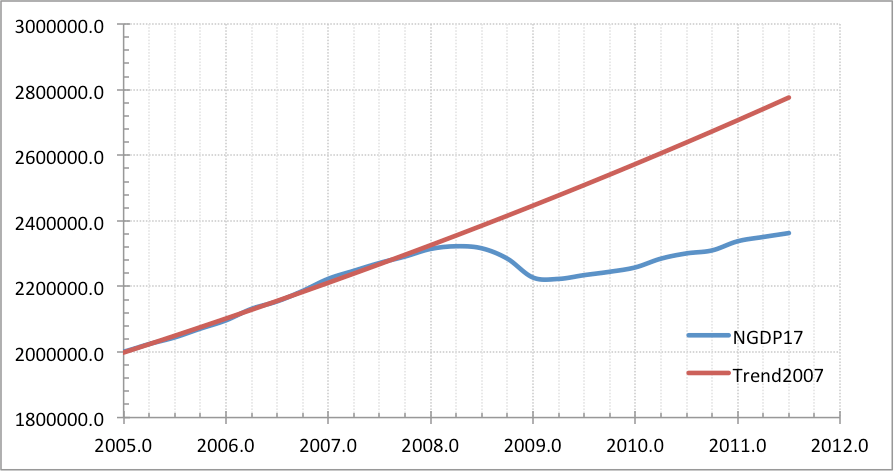
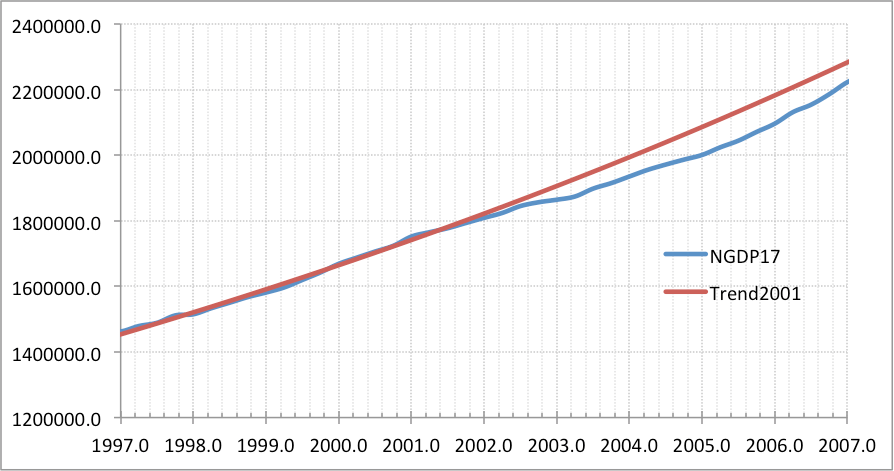
The negative NGDP base drift in the aftermath of the last recession in the Euro area is very significant.  However, this NGDP base drift is even more evil than normally.  Not only is NGAP significantly negative, but it keeps getting worse.  In the second quarter of 2009, NGAP was -10.28%.  Since then NGAP has continued to get worse reaching -14.90% in the third quarter of 2011.

If instead the European Central Bank were to target NGDP and try to return NGDP to its prerecession trend and were successful, these governments’ tax revenue should increase to initially expected levels, eliminating the squeeze.  Many will claim that the European Central Bank is impotent, unable to eliminate this NGAP.  However, as the following graph shows, the European Central Bank has experienced NGDP base previously when it was not impotent.

Because of my work with the issue of price determinacy, I know that expectations is very important to a central bank’s ability to meet its targets.  Since the European Central Bank has let NGDP base drift persist in the past, then the public’s expectation is that they will let the NGDP base drift persist now.  To succeed in eliminating this NGDP base drift, to return NGAP to zero, we need to change expectations.  By committing to NT and following other suggestions the market monetarists and I have, the European Central Bank can change these expectations and eliminate the evil of NGDP base drift.  Rather than kicking the sovereign government borrowers and other debtors while they are down, central banks can return NGAP to zero and help lift these debtors to their feet, which is a lot nicer than kicking them while they are down.

Making Both Borrowers and Lenders Worse off

Up until now I have described the negative NGDP base drift caused by ΔNT and IT as making borrowers worse off while making lenders better off.  However, the latest recession has made so many borrowers so worse off as to cause many borrowers be unable to pay, leading to loan defaults.  Hence, not only has this negative NGDP base drift made borrowers worse off, it has also made lenders worse off.  Reversing the negative NGDP base by following NT rather than IT or ΔNT would thus help not only borrowers, but lenders as well.

Unfortunately, the central banks have either committed to inflation targeting or acted as if they were inflation targeters.  As a result, the expectation of those who recently entered into loan contracts after the negative NGAP occurred is that the central banks would not reverse this NGAP.  If they central banks do reverse this NGAP, then it will make these recent borrowers better off and the recent lenders worse off.  Had the central banks instead committed to a nominal GDP target, then these recent borrowers and lenders would have anticipated the elimination of NGAP.  This then does put the central banks in a difficult position.  Should they reverse the NGAP and return the borrowers and lenders back to their original expected proportions at the expense of more recent borrowers and lenders?  Or should they keep to their promise of nonreversal of NGAP which is consistent with more recent loans, but which will continue to kick the original borrowers while they are down.  It is a difficult decision.  Perhaps they can compromise and partially reverse the NGAP and then commit to a nominal GDP target in the future.

© Copyright (2012) David Eagle

How (un)stable is velocity?

Traditional monetarists used to consider money-velocity as rather stable and predictable. In the simple textbook version of monetarism V in MV=PY is often assumed to be constant. This of course is a caricature. Traditional monetarists like Milton Friedman, Karl Brunner or Allan Meltzer never claimed that velocity was constant, but rather that the money demand function is relatively stable and predictable.

Market Monetarists on the other hand would argue that velocity is less stable than traditional monetarists argued.  However, the difference between the two views is much smaller than it might look on the surface. The key to understanding this is the importance of expectations and money policy rules.

In my view we can not think of money demand – and hence V – without understanding monetary policy rules and expectations (Robert Lucas of course told us that long ago…). Therefore, the discussion of the stability of velocity is in some way similar to the discussion about whether monetary policy whether monetary policy works with long and variable leads or lags.

Therefore, V can said to be a function of the expectations of future growth in M and these expectations are determined by what monetary policy regime is in place. During the Great Moderation there was a clear inverse relationship between M and V. So when M increased above trend V would tend to drop and vice versa. The graph below shows this very clearly. I use the St. Louis Fed’s so-called MZM measure of the money supply.

This is not really surprising if you take into account that the Federal Reserve during this period de facto was targeting a growth path for nominal GDP (PY). Hence, a “overshoot” on money supply growth year one year would be counteracted the following year(s). That also mean that we should expect money demand to move in the direct opposite direction and this indeed what we saw during the Great Moderation. If the NGDP target is 100% credible the correlation between growth in M and growth in V to be exactly -1. (For more on the inverse relationship between M and V see here.)

The graph below shows the 3-year rolling correlation growth in M (MZM) and V in the US since 1960.

The graph very clearly illustrates changes in the credibility of US monetary policy and the monetary policy regimes of different periods. During the 1960 the correlation between M or V was highly unstable. This is during the Bretton Woods period, where the US effectively had a (quasi) fixed exchange rate. Hence, basically the growth of M and V was determined by the exchange rate policy.

However, in 1971 Nixon gave up the direct convertibility of gold to dollars and effectively killed the Bretton Woods system. The dollar was so to speak floated. This is very visible in the graph above. Around 1971 the (absolute) correlation between M and V becomes slightly more stable and significant higher. Hence, while the correlation between M and V was highly volatile during the 1960s and swung between +0 and -0.8 the correlation during the 1970s was more stable around -0.6, but still quite unstable compared to what followed during the Great Moderation.

The next regime change in US monetary policy happened in 1979 when Paul Volcker became Fed chairman. This is also highly visible in the graph. From 1979 we see a rather sharp increase in the (absolute) correlation between money supply growth and velocity growth.  Hence, from 1979 to 1983 the 3-year rolling correlation between MZM growth and velocity growth increased from around -0.6 to around -0.9. From 1983 and all through the rest of the Volcker-Greenspan period the correlation stayed around -0.8 to -0.9 indicating a very credible NGDP growth targeting regime. This is rather remarkable given the fact that the Fed never announced such a policy – nonetheless it seems pretty clear that money demand effectively behaved as if such a regime was in place.

It is also notable that there is a “pullback” in the correlation between M and V during the three recessions of the Great Moderation – 1990-91, 2001-2 and finally in 2008-9. This is rather clear indication of the monetary nature of these recessions.

The discussion above illustrates that the relationship between M and V to a very large degree is regime dependent. So while it might have been perfectly reasonable to assume that there was little correlation between M and V during the 1950s and 1960s that changed especially after Volcker defeated inflation and introduced a rule based monetary policy.

MV=PY is still the best tool for monetary analysis

So while V is far from as stable as traditional monetarists assumed the correlation between M and V is highly stable if monetary policy is credible and there is a clearly defined nominal target. Therefore MV=PY still provides the best tool for understanding monetary policy – and macroeconomics for that matter – as long as we never forget about the importance of monetary policy rules and expectations.

However, the discussion above also shows that we should be less worried about maintaining a stable rate of growth in M than traditional monetarists would argue. In fact the market mechanism will ensure a stable development in MV is the central bank has a credible target for PY. If we have a credible NGDP targeting regime then the correlation between M and V will be pretty close to -1.

—-

PS This discussion of course is highly relevant for what happened to US monetary policy in 2008, but the purpose of this post is to discuss the general mechanism rather than what happened in 2008. I would however notice that the correlation between growth in M and V dropped in 2008, but still remains fairly high. One should of course note here that this is the correlation between the growth of M and V rather than the level of M and V.

PPS In my discussion and graph above I have used MZM data rather than for example M2 data. The results are similar with M2, but slightly less clear. That to me indicates that MZM is a much better monetary indicator than M2. I am sure William Barnett would agree and maybe I would try to do the same exercise with his Divisia Money series.

Josh Barro do indeed favour NGDP level targeting

A couple of days ago I noted that Josh Barro had a good understanding of US monetary policy and the causes of the Great Recession. In my post I wondered whether Josh also would favour NGDP level targeting.

He is Josh’s “answer”:

I would prefer to see the Federal Reserve adopt a rule, such as NGDP level targeting, that would lay out an orderly path for monetary easing in recessions and tightening upon recovery. But I don’t think we need to worry about the Federal Reserve losing its grip on any ad-hoc decisions to allow some moderate inflation. It’s just not in this Fed’s nature—and the markets know it.

The quote above is from an article today in on the Forbes website where he discusses Amity Shlaes’ very odd claim that Milton Friedman would have been against QE in the US over the last couple of years. I don’t want to go into that discussion (I will simply become too upset…). Let me instead quote Josh:

The Cleveland Fed inflation estimates, based on financial market data including the interest rate spread between ordinary and inflation-protected Treasury bonds, show expected inflation of 1.4 percent per year over the next ten years. So, if Shlaes knows about an inflation bomb that the young guns on Wall Street can’t see, she has the opportunity to go make a ton of money in the bond markets.

Inflation isn’t nearly as mysterious as Shlaes makes it out to be. Milton Friedman is on point here: “Inflation is always and everywhere a monetary phenomenon in the sense that it is and can be produced only by a more rapid increase in the quantity of money than in output.” If inflation starts to get out of control, all the Fed has to do is contract the money supply.

The Fed is sure to have to do this in the medium term. The housing crash, banking crisis and recession caused a sharp drop in the velocity of money. MV = PQ, so the Fed had to greatly expand the monetary base in order to prevent deflation. As the velocity of money picks up, the Fed will need to contract the monetary base to prevent rapid inflation.

If it’s this simple, why do countries ever have undesirably high inflation? Sometimes, as with Zimbabwe, it’s because they’re printing money as a fiscal strategy. At other times, as in the U.S. in the 1970s, there is insufficient political will for the sometimes-painful step of monetary contraction.

The former is not a serious fear in the United States. As for the latter, it is possible to imagine a central bank that lacks the discipline to tighten when appropriate. But not this Federal Reserve, which has a strong bias toward disinflation and many of whose members seem to have had to be dragged, kicking and screaming, into the insufficient amount of easing we have had to date.

Josh is obviously completely right and I hope that he in the future will continue to participate in the debate concerning US monetary policy and continue to advocate NGDP level targeting.

PS David Glasner also has a comment on Amity Shlaes’ claims concerning QE and Milton Friedman – HEALTH WARNING! My friend David is moderately critical of Friedman in his comment – despite of this we are still friends;-)

UPDATE: Scott Sumner also has a comment on Josh Barro.

Josh Barro sounds like a Market Monetarist – will he also advocate NGDP targeting?

Josh Barro has an interesting comment on the economic policies of US presidential candidate. However, more interesting really is his comments on past and present US monetary policy:

Just as with fiscal policy, an improving economy will change our monetary policy needs. Contrary to popular opinion, the Federal Reserve has not been irresponsibly “printing money” in recent years. The weak economy has led people to hoard cash instead of spending it — which has more than overcompensated for the Fed’s supposedly aggressive policies.

Today, given the recovering economy, the Fed is now just about loose enough. This hopefully means that the economic recovery will accelerate, no longer held back by bad monetary policy.

But the Fed must resist the urge to tighten prematurely, which could set us back into another slump. A moderate period of moderate inflation is nothing to be afraid of; in fact, it will help underwater homeowners to get out of hock and improve the housing markets.

Josh is of course right. US monetary policy has not been loose, but rather too tight. The recession is a result of a sharp increase in dollar demand. Josh is also right that monetary policy now seem to have become more accommodative. This is visible from the improvement in US macroeconomic data, but obviously also something we can observe directly from the financial markets – rising stock prices, higher bond yields and higher commodity prices. So yes, there certainly seem to be both a recovery and some stabilisation in expectations. Said, in another way it seems like the Fed is regaining some credibility.

That said, the discussion about monetary policy should really not be about whether it is a bit too tight or a bit too loose at the moment. Rather we need to continue to discuss what the Fed should target. There need to be a continued discussion about the Fed’s operational framework and about it’s target. Market Monetarists obviously would prefer that the Fed introduced a NGDP level target. I wonder if Josh Barro would support that?

HT Blake Johnson

Long and variable leads and lags

Scott Sumner yesterday posted a excellent overview of some key Market Monetarist positions. I initially thought I would also write a comment on what I think is the main positions of Market Monetarism but then realised that I already done that in my Working Paper on Market Monetarism from last year – “Market  Monetarism – The  Second  Monetarist  Counter-­revolution”

My fundamental view is that I personally do not mind being called an monetarist rather than a Market Monetarist even though I certainly think that Market Monetarism have some qualities that we do not find in traditional monetarism, but I fundamentally think Market Monetarism is a modern restatement of Monetarism rather than something fundamentally new.

I think the most important development in Market Monetarism is exactly that we as Market Monetarists stress the importance of expectations and how expectations of monetary policy can be read directly from market pricing. At the core of traditional monetarism is the assumption of adaptive expectations. However, today all economists acknowledge that economic agents (at least to some extent) are forward-looking and personally I have no problem in expressing that in the form of rational expectations – a view that Scott agrees with as do New Keynesians. However, unlike New Keynesian we stress that we can read these expectations directly from financial market pricing – stock prices, bond yields, commodity prices and exchange rates. Hence, by looking at changes in market pricing we can see whether monetary policy is becoming tighter or looser. This also has to do with our more nuanced view of the monetary transmission mechanism than is found among mainstream economists – including New Keynesians. As Scott express it:

Like monetarists, we assume many different transmission channels, not just interest rates.  Money affects all sorts of asset prices.  One slight difference from traditional monetarism is that we put more weight on the expected future level of NGDP, and hence the expected future hot potato effect.  Higher expected future NGDP tends to increase current AD, and current NGDP.

This is basically also the reason why Scott has stressed that monetary policy works with long and variable leads rather than with long and variable lags as traditionally expressed by Milton Friedman. In my view there is however really no conflict between the two positions and both are possible dependent on the institutional set-up in a given country at a given time.

Imagine the typical monetary policy set-up during the 1960s or 1970s when Friedman was doing research on monetary matters. During this period monetary policy clearly was missing a nominal anchor. Hence, there was no nominal target for monetary policy. Monetary policy was highly discretionary. In this environment it was very hard for market participants to forecast what policies to expect from for example the Federal Reserve. In fact in the 1960s and 1970s the Fed would not even bother to announce to market participant that it had changed monetary policy – it would simply just change the policy – for example interest rates. Furthermore, as the Fed was basically not communicating directly with the markets market participant would have to guess why a certain policy change had been implemented. As a result in such an institutional set-up market participants basically by default would have backward-looking expectations and would only gradually learn about what the Fed was trying to achieve. In such a set-up monetary policy nearly by definition would work with long and variable lags.

Contrary to this is the kind of set-up we had during the Great Moderation. Even though the Federal Reserve had not clearly formulated its policy target (it still hasn’t) market participants had a pretty good idea that the Fed probably was targeting the nominal GDP level or followed a kind of Taylor rule and market participants rarely got surprised by policy changes. Hence, market participants could reasonably deduct from economic and financial developments how policy would be change in the future. During this period monetary policy basically became endogenous. If NGDP was above trend then market participant would expect that monetary policy would be tightened. That would increase money demand and push down money-velocity and push up short-term interest rates. Often the Fed would even hint in what direction monetary policy was headed which would move stock prices, commodity prices, the exchange rates and bond yields in advance for any actual policy change. A good example of this dynamics is what we saw during early 2001. As a market participant I remember that the US stock market would rally on days when weak US macroeconomic data were released as market participants priced in future monetary easing. Hence, during this period monetary policy clear worked with long and variable leads.

In fact if we lived in a world of perfectly credible NGDP level targeting monetary policy would be fully automatic and probably monetary easing and tightening would happen through changes in money demand rather than through changes in the money base. In such a world the lead in monetary policy would be extremely short. This is the Market Monetarist dream world. In fact we could say that not only is “long and variable leads” a description of how the world is, but a normative position of how it should be.

Concluding there is no conflict between whether monetary policy works with long and variable leads or lags, but rather this is strictly dependent on the monetary policy regime and how monetary policy is implemented. A key problem in both the ECB’s and the Fed’s present policies today is that both central banks are far from clear about what nominal targets they have and how to achieve it – in some ways we are back to the pre-Great Moderation days of policy uncertainty. As a consequence market participants will only gradually learn about what the central bank’s real policy objectives are and therefore there is clearly an element of long and variable lags in monetary policy. However, if the Fed tomorrow announced that it would aim to increase NGDP by 15% by the end of 2013 and it would try to achieve that by buying unlimited amounts of foreign currency I am pretty sure we would swiftly move to a world of instantaneously working monetary policy – hence we would move from a quasi-Friedmanian world to a Sumnerian world.

Without rules we live in Friedmanian world – with clear nominal targets we live live in Sumnerian world.

PS Today is a Sumnerian day – hints from both the Fed and the ECB about possible monetary tightening is leading to monetary policy tightening today. Just take a look at US stock markets…(Ok, Greek worries is also playing apart, but that is passive monetary tightening as dollar demand increases)

NGDP level targeting and the Fed’s mandate

Renee Haltom has an interesting article in the recent edition of Richmond’s Fed’s magazine Region Focus on “Would a LITTLE inflation produce a BIGGER recover?”.

Renee among other things discusses NGDP targeting – it is unclear from the article whether it is a reference to growth or level targeting and somewhat surprisingly Market Monetarists such as Scott Sumner is not mentioned in the discussion. Rather Renee Haltom has interviewed Bennett McCallum. Professor McCallum is of course the grandfather of Market Monetarism so Renee is forgiven for not mentioning Scott.

What I found most interesting in Renee’s discussion was actually the relationship between NGDP targeting and the Fed’s legal mandate:

“NGDP is everything that is produced times the current prices people pay for it. It is similar to “real” GDP, the measure of economic growth reported in the news, except NGDP isn’t adjusted for inflation. One appeal is that growth in NGDP is the sum of exactly two things: inflation and the growth rate of real GDP (the amount of actual goods and services produced). Thus, it captures both sides of the Fed’s mandate in a single variable.”

So what Renee is basically suggesting is a that NGDP targeting would be fully comparable with the Federal Reserve’s mandate – to ensure price stability as well as to maximize employment. Unlike Scott Sumner I don’t think the Fed’s mandate is meaningful. The Fed should not try to maximize employment. In the long run employment is determined by factors completely outside of the Fed’s control. In the long run unemployment is determined by supply factors. In my view the only task of the Fed should be to ensure nominal stability and monetary neutrality (not distort relative prices) and the best way to do that is through a NGDP level target. However, lets play along and say that the Fed’s mandate is meaningful.

In his 2001 paper “U.S. Monetary Policy During the 1990s” Greg Mankiw suggested that Fed’s policy reaction function (for interest rates) could be seen as a function of the rate of unemployment minus core inflation. Lets call this measure Mankiw’s constant. The clever reader will of course notice that we now capture Fed’s mandate in one variable.

The graph below shows Mankiw’s constant and the ‘NGDP gap’ defined as percentage deviation from the trend in nominal GDP from 1990 to 2007 (the Great Moderation period).

The graph is pretty clear – there is a very strong correlation between the Fed’s mandate and NGDP level targeting. If the Fed keeps NGDP on trend then it will also ensure that Mankiw constant in fact would be a constant and fulfill it’s mandate. The graph of course also shows very clearly that the Federal Reserve at the moment is very far from fulfilling its mandate.

Given the very strong correlation between Mankiw’s constant and the NGDP gap it should be pretty easy for the Fed to argue that NGDP level (!) targeting is fully comparable with the Fed’s target. So Ben why are you still waiting?

”Regime Uncertainty” – a Market Monetarist perspective

My outburst over the weekend against the Rothbardian version of Austrian business cycle theory was not my normal style of blogging. I normally try to be non-confrontational in my blogging style. Krugman-style blogging is not really for me, but I must admit my outburst had some positive consequences. Most important it generated some good – friendly – exchanges with Steve Horwitz and other Austrians.

Steve’s blog post in response to my post gave some interesting insight. Most interesting for me was that Steve highlighted Robert Higgs’ “Regime Uncertainty” theory of the Great Depression.

Higg’s thesis is that the recovery from the Great Depression was prolonged due to “Regime Uncertainty”, which hampered especially growth in investment. Here is Higgs:

“The hypothesis is a variant of an old idea: the willingness of businesspeople to invest requires a sufficiently healthy state of “business confidence,” and the Second New Deal ravaged the requisite confidence …. To narrow the concept of business confidence, I adopt the interpretation that businesspeople may be more or less “uncertain about the regime,” by which I mean, distressed that investors’ private property rights in their capital and the income it yields will be attenuated further by government action. Such attenuations can arise from many sources, ranging from simple tax-rate increases to the imposition of new kinds of taxes to outright confiscation of private property. Many intermediate threats can arise from various sorts of regulation, for instance, of securities markets, labor markets, and product markets. In any event, the security of private property rights rests not so much on the letter of the law as on the character of the government that enforces, or threatens, presumptive rights.”

Overall I think Higgs’ concept makes a lot of sense and there is no doubt that uncertainty about economic policy had negative impact on the performance of the US economy during the Great Depression. I would especially highlight that the so-called National Industrial Recovery Act (NIRA) and the Smoot-Hawley tariff act not only had directly negative impact on the US economy, but mostly likely also created uncertainty about core capitalist institutions such as property rights and the freedom of contract. This likely hampered investment growth in the way described by Higgs.

However, I am somewhat critical about the “transmission mechanism” of this regime uncertainty. From the Market Monetarist perspective recessions are always and everywhere a monetary phenomenon. Hence, in my view regime uncertainty can only impact nominal GDP if it in someway impact monetary policy – either through money demand or the money supply.

This is contrary to Higgs’ description of the “transmission mechanism”. Higgs’ description is – believe it or not – fundamentally Keynesian in its character (no offence meant Bob): An increase in regime uncertainty reduces investments and that directly reduces real GDP. This is exactly similar to how the fiscal multiplier works in a traditional Keynesian model.

In a Market Monetarist set-up this will only have impact if the monetary authorities allowed it – in the same way as the fiscal multiplier will only be higher than zero if monetary policy allow it. See my discussion of fiscal policy here.

Hence, from a Market Monetarist perspective the impact on investment will be only important from a supply side perspective rather than from a demand side perspective. That, however, does not mean that it is not important – rather the opposite. What makes us rich or poor in the long run is supply side factor and not demand side factors.

The real uncertainty is nominal

While a drop in investment surely has a negative impact on the long run on real GDP growth I would suggest that we should focus on a slightly different kind of regime uncertain than the uncertainty discussed by Higgs. Or rather we should also focus on the uncertainty about the monetary regime.

Let me illustrate this by looking at the present crisis. The Great Moderation lasted from around 1985 and until 2008. This period was characterised by a tremendously high degree of nominal stability. Said in another way there was little or no uncertainty about the monetary regime. Market participants could rightly expect the Federal Reserve to conduct monetary policy in such a way to ensure that nominal GDP grew around 5% year in and year out and if NGDP overshot or undershot the target level one year then the Fed would makes to bring back NGDP on the “agreed” path. This environment basically meant that monetary policy became endogenous and the markets were doing most of the lifting to keep NGDP on its “announced” path.

However, the well-known – even though not the official – monetary regime broke down in 2008. As a consequence uncertainty about the monetary regime increased dramatically – especially as a result of the Federal Reserve’s very odd unwillingness to state a clearly nominal target.

This increase in monetary regime uncertainty mean that market participants now have a much harder time forecasting nominal income flows (NGDP growth). As a result market participants will try to ensure themselves negative surprises in the development in nominal variables by keeping a large “cash buffer”. Remember in uncertain times cash is king! Hence, as a result money demand will remain elevated as long as there is a high degree of regime uncertainty.

As a consequence the Federal Reserve could very easily ease monetary conditions without printing a cent more by clearly announcing a nominal target (preferably a NGDP level target). Hence, if the Fed announced a clear nominal target the demand for cash would like drop significantly and for a given money supply a decrease in money demand is as we know monetary easing.

This is the direct impact of monetary regime uncertainty and in my view this is significantly more important for economic activity in the short to medium run than the supply effects described above. However, it should also be noted that in the present situation with extremely subdued economic activity in the US the calls for all kind of interventionist policies are on the rise. Calls for fiscal easing, call for an increase in minimum wages and worst of all calls for all kind of protectionist initiatives (the China bashing surely has gotten worse and worse since 2008). This is also regime uncertainty, which is likely to have an negative impact on US investment activity, but equally important if you are afraid about for example what kind of tax regime you will be facing in one or two years time it is also likely to increase the demand for money. I by the way regard uncertainty about banking regulation and taxation to a be part of the uncertainty regarding the monetary regime. Hence, uncertainty about non-monetary issues such as taxation can under certain circumstances have monetary effects.

Concluding at the moment – as was the case during the Great Depression – uncertainty about the monetary regime is the biggest single regime uncertain both in the US and Europe. This monetary regime uncertainty in my view has tremendously negative impact on the economic perform in both the US and Europe.

So while I am sceptical about the transmission mechanism of regime uncertainty in the Higgs model I do certainly agree that we need regime certain. We can only get that with sound monetary institutions that secure nominal stability. I am sure that Steve Horwitz and Peter Boettke would agree on that.

Josh Hendrickson shows that the Fed targeted NGDP growth

I have previously quoted Alan Greenspan for saying the following at a FOMC meeting in 1992:

“Let me put it to you this way. If you ask whether we are confirming our view to contain the success that we’ve had to date on inflation, the answer is “yes.” I think that policy is implicit among the members of this Committee, and the specific instruments that we may be using or not using are really a quite secondary question. As I read it, there is no debate within this Committee to abandon our view that a non-inflationary environment is best for this country over the longer term. Everything else, once we’ve said that, becomes technical questions. I would say in that context that on the basis of the studies, we have seen that to drive nominal GDP, let’s assume at 4-1/2 percent, in our old philosophy we would have said that [requires] a 4-1/2 percent growth in M2. In today’s analysis, we would say it’s significantly less than that. I’m basically arguing that we are really in a sense using [unintelligible] a nominal GDP goal of which the money supply relationships are technical mechanisms to achieve that. And I don’t see any change in our view…and we will know they are convinced (about “price stability”) when we see the 30-year Treasury at 5-1/2 percent.

Now Josh Hendrickson has a new paper out – “An Overhaul of Federal Reserve Doctrine: Nominal Income and the Great Moderation” – that basically confirms that the Fed actually did what Greenspan said it would do – at least during the Great Moderation. Here is the abstract:

“The Great Moderation is often characterized by the decline in the variability of output and inflation from earlier periods. While a multitude of explanations for the Great Moderation exist, notable research has focused on the role of monetary policy. Specifically, early evidence suggested that this increased stability is the result of monetary policy that responded much more strongly to realized inflation. Recent evidence casts doubt on this change in monetary policy. An alternative hypothesis is that the change in monetary policy was the result of a change in doctrine; specifically the rejection of the view that inflation was largely a cost-push phenomenon. As a result, this alternative hypothesis suggests that the change in monetary policy beginning in 1979 is reflected in the Federal Reserve’s response to expectations of nominal income growth rather than realized inflation as previously argued. I provide evidence for this hypothesis by estimating the parameters of a monetary policy rule in which policy adjusts to forecasts of nominal GDP for the pre- and post-Volcker eras. Finally, I embed the rule in two dynamic stochastic general equilibrium models with gradual price adjustment to determine whether the overhaul of doctrine can explain the reduction in the volatility of inflation and the output gap.”

Josh has written and excellent paper and I recommend everybody to have a look at Josh’s paper – maybe if we are lucky Ben Bernanke might also read the paper. After all the paper will be published in Journal of Macroeconomics. Bernanke is on the editorial board of JoM.

PS Josh also has a comment on this on his blog.

Update: Scott Sumner also has a comment on Josh’s paper.